Home / Neighborhoods / Bel Air
Bel Air Homes for Sale
The gates, the canyons, and the views that defined the Los Angeles estate.
Home / Neighborhoods / Bel Air
The gates, the canyons, and the views that defined the Los Angeles estate.
About the Neighborhood
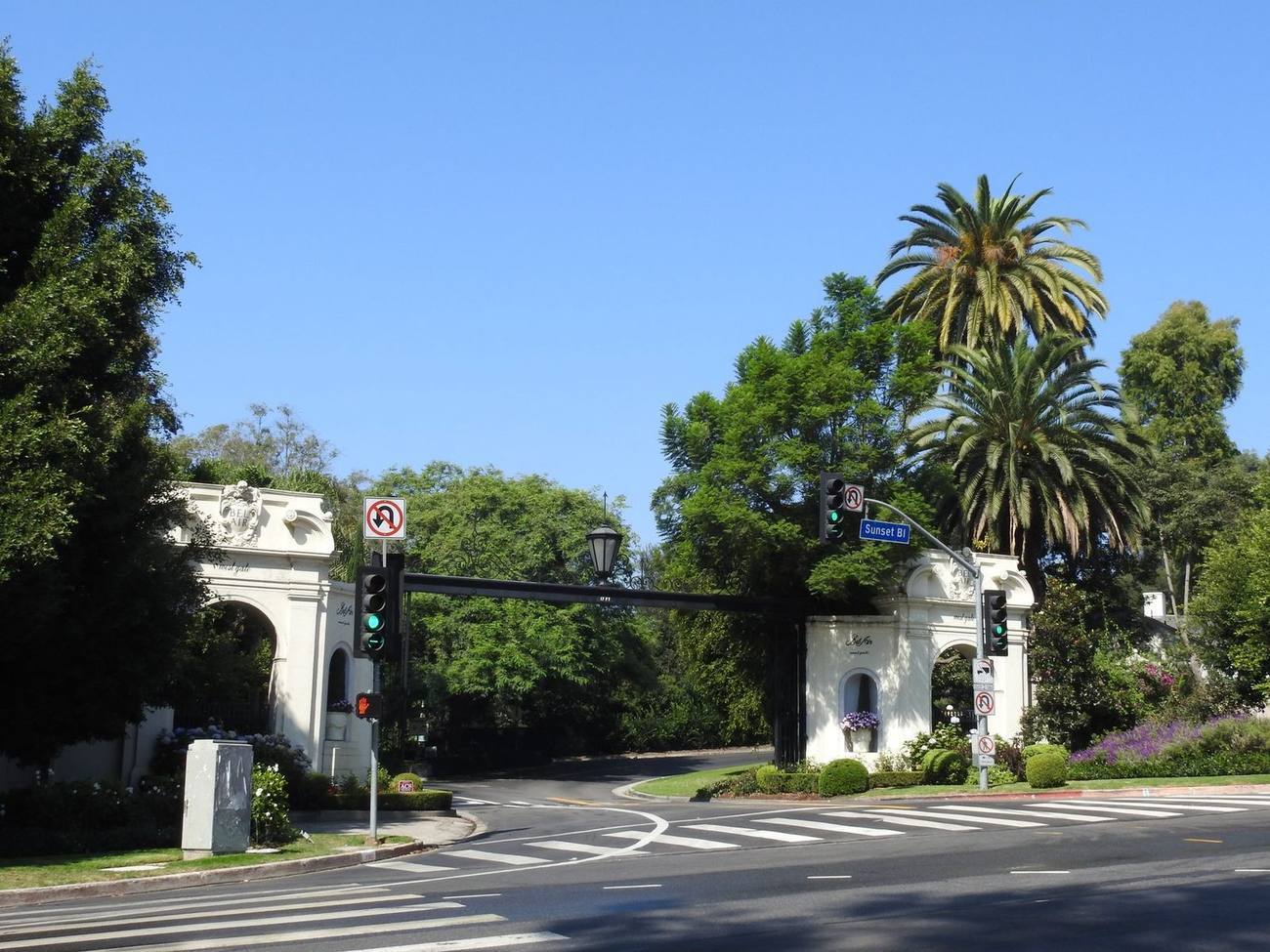
Bel Air was founded in 1923 by oil businessman Alphonzo Bell, who subdivided ranch land that traced back to the 1843 Mexican land grant Rancho San Jose de Buenos Ayres. Bell commissioned landscape architect Mark Daniels to lay out a master plan of roads following the canyon contours, his wife chose the Italian street names — Bellagio, Stradella, Copa de Oro — and gated entrances went up on Sunset Boulevard. The Bel-Air Association, operating since 1942 from the East Gate at 100 Bel Air Road, still reviews neighborhood aesthetics. The Hotel Bel-Air opened on Stone Canyon Road in 1946, giving the district its social anchor.
The housing stock splits into recognized sections. East Gate Old Bel Air, between Beverly Glen and Bel Air Road below Nimes Road, holds the 1920s-1930s Mediterranean, Georgian and Tudor estates on Bellagio Road, St. Cloud Road and Copa de Oro Road. West Gate Bel Air, entered opposite UCLA, mixes prewar houses with postwar construction. Upper Bel Air, along the Roscomare Road and Linda Flora-Chalon corridors toward Mulholland Drive, is largely postwar: ranch houses, midcentury designs and rebuilding that followed the 1961 Bel Air fire, which destroyed hundreds of homes and reshaped whole streets. Contemporary construction now appears in every section.
Bel Air sits entirely within the City of Los Angeles, so building is governed by LA's single-family and hillside rules: RE estate zoning, the Baseline Hillside Ordinance's slope-based floor-area, height and grading limits, and the Hillside Construction Regulation district adopted for Bel Air-Beverly Crest in the late 2010s, which restricts haul routes, cumulative grading and construction activity. Ridge-line parcels near Mulholland fall under that corridor's scenic specific plan, and the whole neighborhood is in a Very High Fire Hazard Severity Zone. The Bel-Air Association's design review is advisory, but the city's entitlement process is not, and it materially limits what can be built.
Daily life is deliberately non-commercial: there are no shops inside Bel Air, so residents use the Glen Centre on Beverly Glen, Westwood Village, or Beverly Hills, each a short drive. Access runs through the Sunset Boulevard gates and over the hill via Roscomare Road or Beverly Glen to the Valley, with the 405 and the Getty Center at the western edge. Stone Canyon Reservoir and the canyon topography keep interior roads narrow, winding and quiet, and many streets have no sidewalks. Buyers searching homes for sale in Bel Air are usually choosing among sections that differ more from each other than from neighboring districts.
Verification should begin with the hillside entitlement stack: confirm zoning, Baseline Hillside floor-area and grading limits, haul-route feasibility and any Mulholland scenic-corridor review before assuming a rebuild or major addition is achievable. Order geology, soils and drainage reports — canyon parcels vary street by street — and price fire insurance early given the fire-zone designation and the neighborhood's fire history. Check whether the street is public or private, what maintenance obligations attach, and whether the parcel participates in the Bel-Air Association. Confirm LAUSD school assignment through the Resident School Identifier, since elementary boundaries in Bel Air split between more than one campus.
Life Here
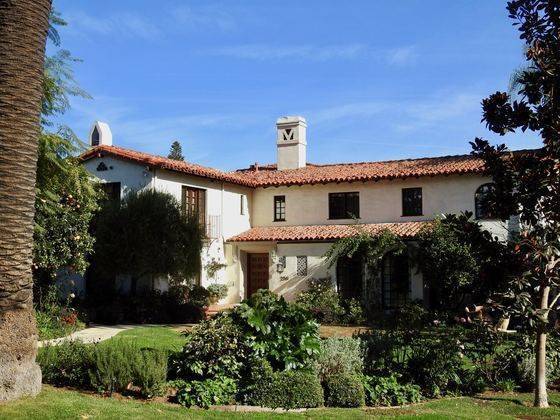
Ivy walls and porte cocheres near the hotel: the estates that built the name.
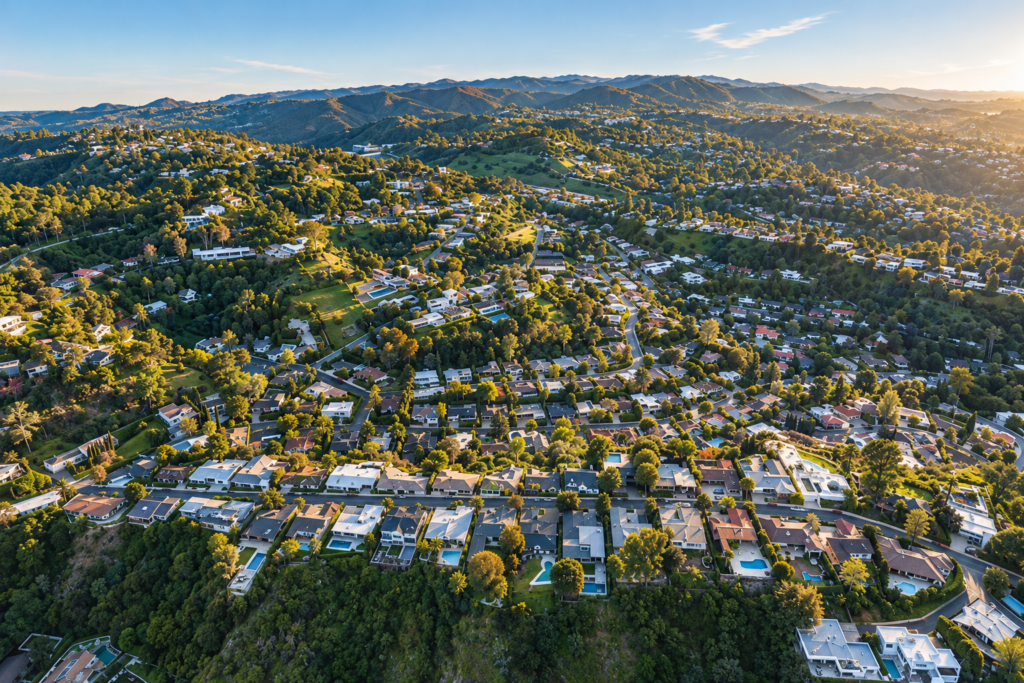
From the upper roads the city becomes a map, and the pricing follows the sightlines.
Swan lake and garden lunches as the neighborhood canteen. Few districts have a better clubhouse.
Education
School assignment follows the individual parcel rather than the postcode, Bel Air splits between elementary boundaries, and enrollment should be confirmed directly with LAUSD or the school.
Common Questions
History
Bel Air exists because of oil. Alphonzo E. Bell Sr. was ranching near Santa Fe Springs when drillers struck one of Southern California's richest fields on his land, and he spent the fortune deliberately: in 1922 he acquired the roughly 1,700-acre Danziger estate in the hills west of Beverly Hills, filed his first 128-lot tract in 1923 and a second in 1925, and set out to build an estate district rather than a subdivision. Landscape architect Mark Daniels bent the roads along the canyon contours, Bell's wife supplied the Italian street names, and the Bel-Air Country Club was incorporated in 1924. Bell's 1927 estate-planning office on Stone Canyon Road found a second life, from 1946 onward, as the Hotel Bel-Air.
The gates gave the neighborhood its grammar. Bell marked the Sunset Boulevard entrances with ornamental portals, the East Gate at Bel Air Road and the West Gate at Bellagio Road opposite the future UCLA campus, and the land behind each developed its own character, a distinction Bel Air real estate still prices carefully. Since 1942 the Bel-Air Association, headquartered beside the East Gate at 100 Bel Air Road, has acted as the community's civic spine: it reviews plans in an advisory capacity, funds patrols and beautification, and speaks for more than 2,000 properties at City Hall. Bell's original deed restrictions, including an often-recounted early policy of refusing sales to film actors, fell away; the stewardship culture he seeded did not.
November 6, 1961 remains the dividing line in the neighborhood's memory. A wind-driven brush fire crossed from the Valley side and burned roughly 6,000 acres through Bel Air and Brentwood, destroying 484 homes, Burt Lancaster's and Zsa Zsa Gabor's among them, without taking a single life. Los Angeles responded by banning wood-shingle roofs on new construction and adopting brush-clearance requirements that remain among the nation's strictest. Upper Bel Air rebuilt through the 1960s, frequently in the modern styles of the moment, and the disaster's lesson runs beneath today's hillside regulations. A smaller fire in December 2017 cost six homes; the estate market has long since priced fire stewardship, from clearance to hardening to insurance, into the ordinary work of living in Bel Air.
Architecture
The founding era built the canon. James E. Dolena's Casa Encantada, completed in 1938 on Bellagio Road for Hilda Boldt Weber and later owned by Conrad Hilton, is routinely counted among the finest houses in the American West, its interiors executed with T.H. Robsjohn-Gibbings. Sumner Spaulding's Chartwell on Bel Air Road, a French Neoclassical estate commissioned in the early 1930s by engineer Lynn Atkinson, whose wife by most accounts found it too grand and never moved in, passed to hotelier Arnold Kirkeby and lent its facade to The Beverly Hillbillies. Around them, the East Gate streets filled with Mediterranean, Georgian and Tudor designs from the period's leading offices, the fabric that still defines old Bel Air.
The postwar decades added a midcentury layer, most visibly in upper Bel Air. Craig Ellwood's Case Study House No. 16, built in 1952-53 on Bel Air Road for the Arts & Architecture magazine program and now listed on the National Register of Historic Places, survives as the best preserved of his Case Study commissions. Richard Neutra's 1959 Singleton House on Mulholland Drive, designed for Teledyne co-founder Henry Singleton and later home to Vidal Sassoon, brought international-style rigor to the ridgeline. After 1961, burned streets along Roscomare Road and Linda Flora Drive rebuilt in ranch and post-and-beam idioms, giving the upper hills a character closer to the Case Study ethos than to the Bellagio Road estates below.
The current era is one of scale, and of the rules that now contain it. Speculative giga-estates crested with The One, the roughly 105,000-square-foot Airole Way project that spent a decade in construction before its developer's bankruptcy sent it to auction in March 2022, where it brought $126 million, about $141 million with fees. More conventionally, Chartwell's late-2019 sale, widely reported at about $150 million, set a California benchmark. Building today runs through the city's Baseline Hillside Ordinance, which ties floor area, height and grading to slope, and the Bel Air-Beverly Crest Hillside Construction Regulation district, which polices haul routes and cumulative earth movement. Ambition remains legal in Bel Air; it simply files for permits first.
Understanding the Market
Bel Air homes for sale span a wider price architecture than any adjacent district, and geography explains most of it. The lower neighborhood, meaning the East Gate streets such as Bellagio, St. Cloud and Copa de Oro and the West Gate blocks around the country club, carries the estate parcels, gated motor courts and provenance houses that set the top of the Los Angeles market. Upper Bel Air, along Roscomare Road and the Linda Flora and Chalon corridors, trades at meaningful discounts to the estate streets: postwar and rebuilt contemporary homes, often with canyon or city views, that serve as the neighborhood's entry point. Between the two, pricing turns on land, view and buildability more than on square footage.
The gates deserve precision. Bel Air's Sunset Boulevard portals are markers, not checkpoints; the East and West Gates stand open, and Association streets are public. Genuinely guard-gated living exists in discrete pockets, most prominently Bel Air Crest, a master-planned enclave off Sepulveda Boulevard near the 405 and Mulholland, developed around the turn of the 1990s and described in community materials as offering a clubhouse, tennis courts, pool and fitness center behind a staffed gate. It operates as a conventional HOA, a different proposition from the Bel-Air Association's advisory stewardship of the historic sections. Buyers weighing living in Bel Air should decide early which model, amenity-rich gate or estate-street autonomy, they are actually buying.
Practical guidance begins with the land. Canyon-floor parcels along Stone Canyon offer seclusion and mature tree cover but less light and view; promontory lots deliver the skyline and carry geology, access and fire-hardening questions that diligence must answer before valuing a rebuild. On schools, Roscomare Road Elementary, inside upper Bel Air, and Warner Avenue Elementary in Westwood are the zoned LAUSD campuses, with Community Magnet Charter occupying the Bellagio Road site by citywide application; assignments split by parcel, so verify the exact address rather than the neighborhood name. Engage the fire-insurance market early, because in Bel Air Los Angeles insurability increasingly shapes what a property is worth, and confirm the hillside entitlement envelope before paying for potential.
Micro Neighborhoods
The original 1923 tract behind the East Gate at Bel Air Road is the neighborhood's historic core: Bellagio Road, St. Cloud Road, Copa de Oro Road and Nimes Road, where Mediterranean, Georgian and Tudor estates from the founding decades occupy some of the most valuable residential land in the American West. The Bel-Air Association keeps its offices beside the gate at 100 Bel Air Road, and Casa Encantada anchors the district's architectural reputation. Streets are quiet, hedged and largely without sidewalks, and parcels trade rarely. This is the Bel Air that gave the name its meaning.
Entered from Sunset Boulevard opposite UCLA, the West Gate section winds up Bellagio Road past the Bel-Air Country Club, incorporated in 1924 and still the district's social center of gravity. The housing mixes surviving prewar estates with substantial postwar construction and newer rebuilds, and the western edge enjoys the most convenient access in Bel Air, with the 405, the Getty Center and Westwood minutes away. For buyers, the West Gate often pairs an estate-district address and acreage with somewhat gentler pricing than the East Gate's marquee streets, though its premier golf-adjacent parcels compete with any in the neighborhood.
Stone Canyon Road runs the neighborhood's green center, past the Hotel Bel-Air, opened in 1946 in Alphonzo Bell's former planning offices, and up toward Stone Canyon Reservoir, whose fenced watershed keeps the canyon's heart permanently undeveloped. Houses here choose seclusion over spectacle: sycamore shade, deep lots, gated drives glimpsed rather than seen. The trade-offs are honest ones, including less light on the canyon floor, a winding two-lane road, and hillside diligence on the slopes. For buyers who define luxury as privacy, Stone Canyon is often the first street they ask about.
Above Nimes Road the neighborhood changes register. Upper Bel Air, along Roscomare Road, Linda Flora Drive, Chalon Road and Stradella Road climbing toward Mulholland, is largely postwar, shaped by the rebuilding that followed the 1961 fire and by the view lots the ridgelines offer. Midcentury houses, ranch originals and contemporary rebuilds dominate, and Roscomare Road Elementary sits within the district. Pricing generally runs below the estate streets, which makes Upper Bel Air the working answer for buyers who want the address and the views without East Gate scale. Parcels near Mulholland carry additional scenic-corridor review.
Bel Air Crest is the outlier: a master-planned, guard-gated community reached from Sepulveda Boulevard near the 405 and Mulholland, developed around the turn of the 1990s. Community materials describe a clubhouse, pool, tennis and basketball courts and a fitness center, resort amenities the historic sections never contemplated, with homes ranging from grand-scale houses to comparatively modest footprints by Bel Air standards. It runs as a conventional HOA with dues and rules, so diligence looks more like a planned-community purchase than an estate one. For buyers prioritizing staffed security and turnkey amenity, it is Bel Air's most direct answer.
Moraga Drive, in the neighborhood's western canyon, holds one of the city's least probable land uses: a working vineyard. Director Victor Fleming ran the property as a horse ranch in the 1930s and 1940s; Northrop chief executive Thomas V. Jones bought it in 1959 and planted terraced vines in 1978; and Rupert Murdoch acquired the estate in 2013 after seeing it advertised in the Wall Street Journal. Moraga Bel Air's roughly sixteen acres of vineyard are often described as the only commercial winery operating inside Los Angeles city limits. The surrounding gated lane is quiet, low-profile and rarely on the market.
Beverly Glen Boulevard draws Bel Air's eastern boundary and lives a different life from the estate streets it borders. The canyon is one of the Westside's essential passages, carrying Sunset Boulevard traffic over the hill to the San Fernando Valley, and its folds hold a village-like community of houses on wooded lanes, from cottages and midcentury perches to substantial newer homes. The Glen Centre near the crest supplies the restaurants and market that gate-side Bel Air deliberately lacks. For buyers committed to the canyons but not to estate pricing, Beverly Glen is the natural first alternative.
View Beverly GlenKeep Exploring
Deciding between them? Read Bel Air vs Holmby Hills.

Also in this part of the city: Benedict Canyon
Work With Ben
From the East Gate to the ridgelines, value here is street by street. Tell Ben what you are looking for, including off market.
Start the ConversationBen will reach out shortly to set up your tour.