Home / Neighborhoods / Malibu Colony
The original film colony on the sand: about a mile of narrow beachfront lots behind a private gate, west of the Malibu Lagoon.
About the Neighborhood
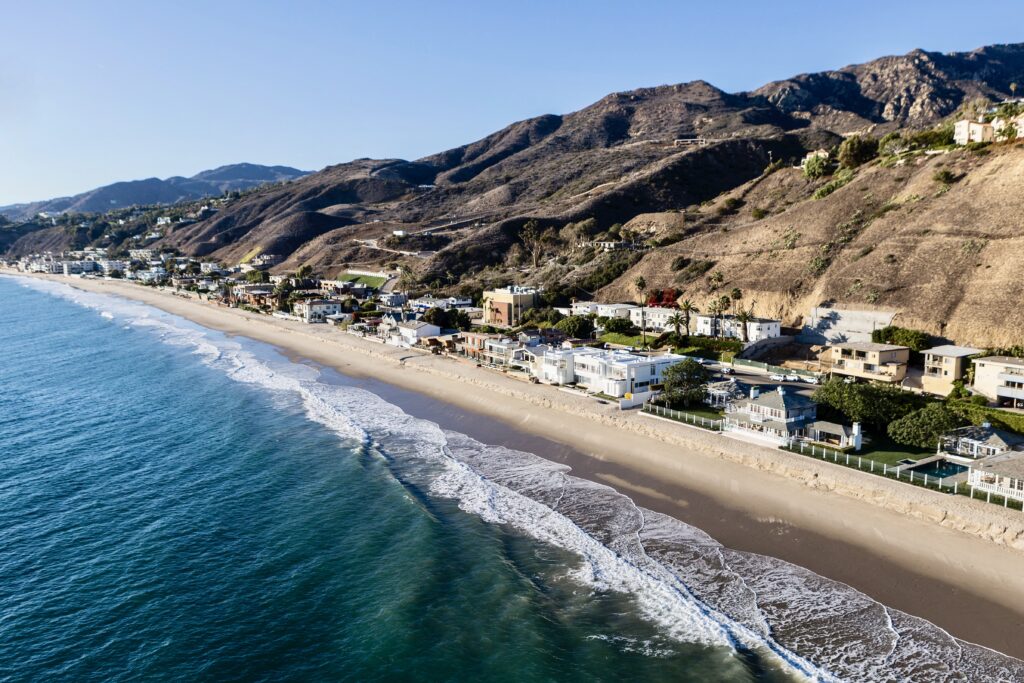
Malibu Colony is the enclave that gave the coast its vocabulary. Roughly a mile of south-facing beach immediately west of the Malibu Lagoon, it is organised around one private road with houses on both sides: the ocean row standing directly on the sand and the landside row facing it across the street. Local counts commonly put the community at about 120 residences. The gate, the guard and the road are the community's defining infrastructure, and Malibu Colony homes for sale are sold as much on that structure as on the water, because the enclave functions like a village rather than a row of separate trophies.
The Colony began in 1926 as a lease tract. May Rindge, sole owner of the Rancho Malibu after her husband Frederick's death in 1905, began renting narrow beachfront lots while she was still fighting the state over a public road across her land. Contemporary accounts describe ten-year leases at thirty dollars a month on lots about thirty feet wide, with the requirement that structures be temporary and removable. Anna Q. Nilsson and Richard Dix were among the first lessees; Ronald Colman, Gloria Swanson, Mary Pickford and Douglas Fairbanks followed, and by 1928 roughly fifty cottages stood on the sand.
That thirty-foot module still governs the architecture. Ocean-side houses are built nearly to their side lines, tall and deep rather than wide, with the living floor lifted for light and a deck cantilevered toward the water. Landside parcels are often two or three times deeper, which is where the Colony hides its tennis courts, motor courts and guest quarters. The effect is a dense, walkable street where neighbours know each other's cars, and it is the reason Malibu Colony real estate reads as communal in a way that isolated beachfront compounds elsewhere in Malibu deliberately do not.
Practical life runs through the gate. A staffed entrance controls the private road, which means showings, inspections, appraisals, deliveries and construction crews all require clearance in advance, and that logistics reality shapes how the Colony is marketed. Errands are immediate: Malibu Colony Plaza sits just outside on Malibu Road with a supermarket and everyday services, the Civic Center and Malibu Village are minutes east, and the Malibu Lagoon, the Adamson House and Surfrider Beach are within walking distance. Malibu Middle and High School and Webster Elementary are all a short drive up the coast.
Diligence on the sand is its own discipline. Confirm where the parcel's seaward boundary actually falls, since private ownership stops at the mean high tide line and the state expects a boundary determination from the State Lands Commission for beachfront work. Ask for the wave uprush study, the condition and permit history of any seawall, revetment or caisson foundation, and the recorded lateral access easements that have accompanied coastal permits since the 1970s. Older beach structures also hide deferred maintenance in piles, decks and utilities, so budget a structural inspection that looks under the house rather than at it.
Life Here
The Colony is a single private street with the ocean row on the sand and the landside row across from it. Beachfront lots run about thirty feet wide and build to their limits; landside parcels are deeper and hold the courts, courtyards and guest quarters. Neighbours are close enough that the enclave behaves like a village.
The beach faces south, so sun tracks across it all day rather than dropping behind a bluff, and the water is calmer here than on the exposed western beaches. The Malibu Lagoon, the Adamson House and Surfrider Beach sit just east, which puts the coast's oldest landmarks within a walk of the gate.
A staffed entrance controls the private road, and everything from a showing to a plumbing call clears in advance. That friction is the point: it keeps the road quiet and the street private, and it is why sellers plan their marketing around access rather than around signage.
History
Frederick Rindge bought Rancho Topanga Malibu Sequit in 1892, and after his death in 1905 May Rindge spent decades resisting a public road across the property, a campaign that included building a private railway and reached the United States Supreme Court before the Roosevelt Highway opened in 1929. In 1926, while that fight was still running, she began leasing beachfront lots to film people. The terms were modest and pointedly temporary: ten-year leases, about thirty dollars a month, lots roughly thirty feet wide, and structures that had to be removable, with a clause against alcohol on the premises.
The tenants arrived quickly. Anna Q. Nilsson and Richard Dix were among the first, joined by Ronald Colman, Gloria Swanson, Mary Pickford and Douglas Fairbanks, and by 1928 about fifty cottages stood on the sand. Many were built by studio carpenters from inexpensive materials, finished in whatever the scene shops had on hand, and named for pictures their occupants had made, which produced a beachfront that ran from Spanish Colonial Revival to Nordic and Gothic Revival within a few hundred feet. A 1929 electrical fire destroyed roughly thirty of them, and the rebuilding that followed marked the shift from removable beach shacks to permanent houses, several commissioned by studio executives and directors who intended to stay.
The Rindge fortune did not survive the transition. The family's Marblehead Land Company entered bankruptcy in 1936, May Rindge died in 1941 with almost nothing, and the ranch was broken up and sold through the following decades, with the Colony's leaseholds giving way to fee ownership over that period; accounts differ on precisely when individual lots converted. The enclave has since been rebuilt house by house rather than all at once, which is why a single street can hold a restored mid-century, a 1980s beach house and a new build behind matching hedges.
Architecture
The Colony's constraint is its plan. A lot about thirty feet wide and deep, hemmed by neighbours on both sides and fronting the ocean, produces a specific house: entry and garage at the road, service rooms and bedrooms below or behind, the main living floor raised toward the light, and a deck projecting over the sand. Vertical circulation does the work that a wide lot would do elsewhere, and stairs, light wells and roof terraces carry the plan. Because the row is continuous, elevations facing the street are often modest and closed, while the ocean elevations are almost entirely glass and open along their full width.
The most consequential house on the street is documented rather than rumoured. John Lautner designed the Stevens House at 78 Malibu Colony Road in 1967 to 1968, solving a lot that other architects had declined by carrying the roof on steel beams shaped into opposed catenary curves, so the interior reads as a set of wave forms rather than as rooms in a box. The producer Michael LaFetra restored it after acquiring it in the 2000s, and it remains the clearest demonstration that the Colony's dimensions are an architectural problem worth solving rather than a limit.
Everything else on the street reflects its decade. Late-1920s cottages survive in fragments inside later shells; the postwar era brought flat-roofed beach houses and shingle-clad additions; the 1980s and 1990s produced the tall, gabled, multi-level beach house that still defines much of the row; and current construction favours warm minimal volumes, folding glass, wood soffits and lime-washed plaster. Landside parcels carry the more relaxed architecture, since depth allows courtyards, motor courts and single-storey plans that the beachfront row simply cannot accommodate. Renovation on either side runs through both the association and the city's coastal permitting, which is why work here is planned in seasons rather than weeks.
Understanding the Market
The Colony trades on a different axis from the rest of Malibu's beachfront. Buyers here are paying for the gate, the guarded road and the sense of an actual street rather than for maximum frontage, and the thirty-foot module means comparisons are made in linear feet on the sand and in the quality of the rebuild rather than in raw square footage. Landside houses trade at a discount to the ocean row but hold their own steady audience, because they offer depth, parking, gardens and quiet without the maintenance exposure that comes with a structure standing in the surf zone.
Turnover is low and marketing is constrained by the gate itself, since every showing, inspection, appraisal and staging call must be cleared in advance with the guard. That single fact pushes a meaningful share of Colony activity into private channels: owners talk to neighbours, neighbours talk to a small group of agents, and a house can change hands before a photographer is ever booked. Buyers who wait for public listings see a fraction of what actually trades, and sellers who ignore the access logistics lose the first weeks of their marketing window, which are the weeks that set the price.
Condition is the market's real variable. Beach structures age hard, and the difference between a house with recent caisson and deck work, a documented seawall permit and a clean coastal file, and one without, is far larger here than in an inland neighbourhood at a similar price. That gap is also where most of the negotiation happens, because the cost of correcting a compromised foundation or an unpermitted addition is rarely small. Anyone shopping Malibu Colony homes for sale should price the diligence rather than only the address, and should expect escrows long enough to accommodate structural, coastal and boundary review.
Micro Neighborhoods
The seaward side of Malibu Colony Road is the reason the enclave exists: houses standing directly on south-facing sand, generally on lots about thirty feet wide, built up and back rather than out, with decks cantilevered toward the water. Ownership stops at the mean high tide line, and many parcels carry recorded lateral easements across the dry sand from earlier coastal permits. These are the houses where seawall permits, caisson condition and wave uprush studies decide value, and where a clean coastal file is worth real money at closing.
Across the road, the north-side parcels run two to three times deeper than the beachfront lots, which allows courtyards, motor courts, pools, tennis and guest quarters that the ocean row cannot fit. Houses tend to sit lower and sprawl more, and the architecture is calmer for it. Owners here get the gate, the guard and the walk to the sand without the maintenance and exposure of a structure in the surf, which is why the landside has a steady following among buyers who plan to be in residence year-round.
Just outside the gate, Malibu Colony Plaza on Malibu Road carries a supermarket, pharmacy, cafes and everyday services, which is what makes daily life in the Colony workable without a drive up the coast. Malibu Road itself continues west as a separate beachfront market of larger, ungated houses on the sand, a useful comparison set for Colony buyers. The Real Deal has reported the plaza among the local retail holdings of Stan Kroenke, one of several centres in Malibu under single ownership.
East of the Colony, Malibu Creek meets the ocean at Malibu Lagoon State Beach, with Surfrider Beach, the Malibu Pier and the Adamson House and Malibu Lagoon Museum within a short walk. The Adamson House, built for May Rindge's daughter Rhoda and her husband Merritt Adamson and finished in tile from the family's Malibu Potteries, is the best surviving physical record of the era that produced the Colony. The lagoon also explains the beach itself, since the creek shapes the sand in front of the enclave.
Inland of the lagoon, Serra Retreat occupies the knoll where the Rindge family's unfinished mansion stood before the Franciscan Order bought 26 acres in 1942 and established the retreat that gives the neighbourhood its name. Today it is a gated enclave of large parcels a few minutes from the Colony gate, with canyon and ocean views instead of frontage. Colony buyers who want land, garages and a garden rather than a deck on the sand often look here first, and the two markets trade against each other regularly.
View Serra RetreatEducation
Malibu's public campuses currently belong to Santa Monica-Malibu Unified, with separation agreements toward a Malibu district approved in late 2025 and state-level steps still pending; assignment follows the individual parcel, so confirm the address with the district and confirm admissions directly with any private school.
Common Questions
Work With Ben
Colony houses often move between neighbours, longtime owners and a small circle of agents before they are ever advertised. Tell Ben what you want on the sand and he will work the gate from the inside, including off-market openings, and read the coastal file before you tour.
Start the ConversationBen will reach out shortly to set up your tour.