Home / Neighborhoods / Trousdale Estates
Trousdale Estates Homes for Sale
Single-storey moderns on graded pads above Sunset, where the code protects the view.
Home / Neighborhoods / Trousdale Estates
Single-storey moderns on graded pads above Sunset, where the code protects the view.
About the Neighborhood
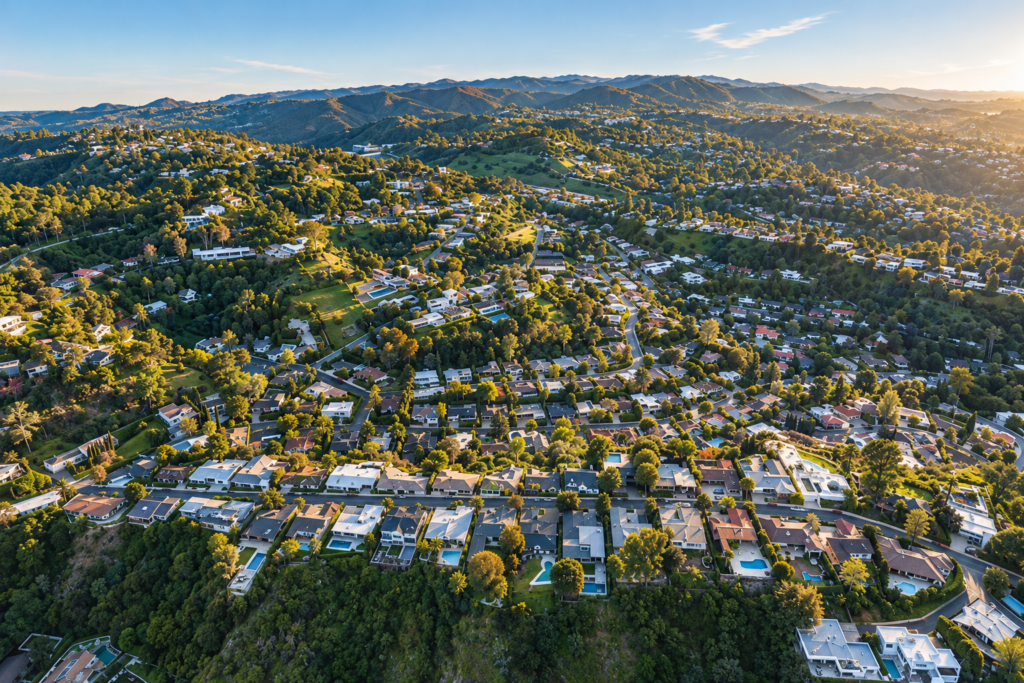
Trousdale Estates covers roughly 410 hillside acres carved from the Doheny family's Greystone ranch at the northern edge of Beverly Hills. Developer Paul Trousdale bought the land in 1954, persuaded the city council to annex it, and platted about 532 lots that sold and built out through the late 1950s and 1960s. Allen Siple acted as supervising architect, and individual houses came from Wallace Neff, Paul R. Williams, A. Quincy Jones, Harold Levitt and Rex Lotery, among others. Few Los Angeles hillside neighborhoods were master-planned this deliberately, which is why Trousdale Estates real estate still reads as a coherent midcentury district.
The housing stock is defined by single-story houses set on graded pads along Loma Vista Drive, Carla Ridge, Hillcrest Road and Doheny Road. Original construction ran to mid-century modern and Hollywood Regency: low rooflines, post-and-beam structure, walls of glass opened toward city and, on clear days, ocean views. Lots typically range from around a third of an acre to more than an acre, wide and relatively shallow, with the house pushed to the view side of the pad. Many originals have been remodeled or replaced by flat-roofed contemporary homes that keep the one-story profile the code requires, so streetscapes remain unusually consistent.
Building in Trousdale is governed by its own article of the Beverly Hills municipal code, separate from the city's Central and Hillside areas. New structures are limited to a 14-foot building height, which in practice means a single story, with floor-area caps tied to lot size and construction largely confined to the existing graded pad rather than new hillside cuts. A 2011 ordinance added height limits for fences, walls and hedges together with a view-restoration process, so mature landscaping cannot lawfully wall off a neighbor's outlook. Basements, roof decks and any variance from the height envelope require city review, and approvals are parcel-specific.
Day to day, Trousdale Estates is purely residential: no retail, no through commercial traffic, and wide, quietly curving streets engineered in the 1950s for cars rather than sidewalks. The main entrance climbs Doheny Road past Greystone Mansion and its public park, and Loma Vista Drive carries most local traffic up the hill. Sunset Boulevard, the Beverly Hills business triangle and the amenities of Santa Monica Boulevard sit a short drive below, while Coldwater Canyon and Benedict Canyon provide routes toward the San Fernando Valley. Buyers searching homes for sale in Trousdale Estates are usually weighing view orientation street by street.
Anyone buying in Trousdale should verify the entitlement picture before valuing the view. Confirm with Beverly Hills Community Development how the 14-foot height limit, floor-area formula and pad-confinement rules apply to the specific lot, and whether an existing larger structure is legally nonconforming. Check which view protections run for and against the property under the fence-and-hedge ordinance, review geology and retaining-wall history on the graded pad, and note that the neighborhood association is advisory rather than a CC&R-enforcing HOA. School assignment within Beverly Hills Unified should be confirmed through the district's school finder, since campuses have been reorganized in recent years.
Life Here
The original committee required one-storey houses of at least three thousand square feet; city hillside rules now cap height at fourteen feet, so rooflines stay low.
Beverly Hills bars construction that substantially disrupts the basin view from a neighbouring building pad within three hundred feet.
Wallace Neff, Paul R. Williams, A. Quincy Jones, Cliff May, Lloyd Wright, Harold Levitt, Edward Fickett and John Elgin Woolf all built here.
History
Before a single pad was graded, this land was the private ranch of oil magnate Edward L. Doheny, who assembled hundreds of acres above the young city of Beverly Hills. The family's ambitions for the hills were serious: in 1923 Frank Lloyd Wright drew an unbuilt resort scheme for the Doheny Ranch, terraced textile-block houses following the contours, in drawings now held by the Library of Congress, and in 1928 the Dohenys completed Greystone Mansion at the property's foot as a gift to Edward 'Ned' Doheny Jr. The upper ranchland stayed largely empty for decades afterward, until Ned's widow, Lucy Smith Doheny Battson, sold roughly 410 acres to developer Paul Trousdale in 1954, closing the estate era and opening the subdivision one.
Paul Trousdale was already among Southern California's most prolific builders. His Trousdale Construction Company, founded in 1946, put up more than 25,000 homes from Westdale to Palm Springs and Hawaii, yet this was the only project to which he attached his own name. Rather than build under Los Angeles rules, he petitioned Beverly Hills to take the tract, and Los Angeles County records show the annexation became effective August 29, 1955, adding roughly six-tenths of a square mile to the city. Crews cut the slopes into broad terraced pads, the subdivision map recorded 532 lots governed by an architectural committee, and his Los Angeles Times obituary recalled one-acre homesites initially offered around $40,000. Sales and construction ran from the late 1950s well into the 1970s.
Trousdale seeded the neighborhood with names. Frank Sinatra commissioned a Paul R. Williams house completed in 1956 and showed it to America on Edward R. Murrow's Person to Person; Groucho Marx built with Wallace Neff in 1958; Dean Martin and Dinah Shore followed; Richard Nixon settled here after the 1960 election; and Elvis Presley bought 1174 Hillcrest Road in 1967. By the 1980s and 1990s the low glass houses read as dated, and many were remodeled past recognition. The pendulum swung back through the 2000s as collectors rediscovered the pedigree, a story told in Steven M. Price's 2017 monograph on the neighborhood, and Trousdale Estates real estate completed its arc from time capsule to one of Beverly Hills' most decisively trophy markets.
Architecture
The Los Angeles Conservancy describes Trousdale as the city's largest and most complete grouping of custom mid-century modern architecture, and the attributions bear that out. Beyond supervising architect Allen Siple, the Conservancy's roster includes Wallace Neff, Paul R. Williams, A. Quincy Jones, Lloyd Wright, Cliff May and Richard Dorman; Harold Levitt, Rex Lotery, Edward Fickett and Hollywood Regency specialist John Elgin Woolf worked here as well. Documented commissions range from Williams' 1956 Sinatra residence, demolished in 2006, to Neff's 1958 house for Groucho Marx, Lotery's Calvet residence on Loma Vista Drive, and Levitt designs on these streets have been documented in the architectural press. Coverage of the neighborhood's 2010s resurvey counted more than a hundred notable-architect houses in a single section of the tract.
The original houses were engineered for arrival and outlook in equal measure. A minimum size of 3,000 square feet, the committee's floor rather than its ceiling, spread rooms across one level behind motor courts and oversized double doors that opened onto entry courtyards before the view was revealed. Living areas flowed around sunken bars and wide fireplaces, glass walls slid away to terraces, and illuminated pools pushed toward the basin's edge. Sinatra's Williams house carried built-in hi-fi cabinetry, ceiling speakers and acoustically engineered walls, an early argument that technology belonged inside the architecture. Stylistically the tract ran a spectrum from taut steel-and-glass modernism to mansard-roofed Hollywood Regency, a mix the Conservancy characterizes as restraint and extravagance, unified by the flat, horizontal massing the hillside demanded.
New construction has become the neighborhood's third act, and it works within an unusually disciplined envelope. Because height is capped and building stays on the graded pad, contemporary architects gain volume by excavating: subterranean levels, light wells and sunken courts beneath single-story glass pavilions. Published projects, such as the Trousdale house by Dennis Gibbens Architects featured on ArchDaily, show the prevailing language of long horizontal planes, stone, glass and water framing the view line. The result is rare in Los Angeles: a regulation written to protect views has effectively made midcentury massing permanent, so original mid-century modern homes in Beverly Hills and their contemporary successors sit side by side at the same roofline. Buyers weigh restored pedigree originals against turnkey rebuilds, and both trade on the same horizon.
Understanding the Market
Pricing in Trousdale is structured first by the view. Rim pads along Carla Ridge, Wallace Ridge and upper Loma Vista command panoramas sweeping from the downtown skyline across the basin, with ocean glimpses on clear days, and they anchor the top of the market; mid-slope streets trade on city-light views; parcels oriented toward canyon greenery and Greystone form the entry tier. The second variable is the structure itself: unrenovated originals tend to trade close to land value, documented architect houses carry provenance premiums, and finished contemporary rebuilds set the records, with trades widely reported at $65 million in 2017 and $72.5 million in 2019. Much of the neighborhood is commonly cited as an eight-figure market, with lot width and pad scale deciding position within each tier.
Demand here has a demographic logic. Single-level living is the scarcest commodity in luxury hillside real estate, and Trousdale offers it at scale: no stairs, wide pads, and floor plans built for entertaining rather than climbing. That draws established buyers consolidating from multi-story estates, international purchasers who want Beverly Hills city services with genuine privacy, and design collectors pursuing documented architects. The neighborhood's protections do quiet work in the background, because a buyer of a view here is buying something the code actually defends, which is not true in most of the hills. Living in Trousdale Estates also means proximity: the business triangle sits minutes below, so the seclusion never costs convenience, a combination few competing enclaves can honestly claim.
Choosing within the neighborhood is a matter of trade-offs rather than rankings. The rim delivers the widest sightlines but carries the newest, largest construction, so buyers seeking original fabric often look mid-slope, where architect houses survive in greater numbers. Lower streets near Doheny Road give the fastest run to Sunset Boulevard and the Flats, gentler driveways and a leafier, more sheltered feel in exchange for narrower views. Orientation matters as much as elevation, since southwest exposures take the ocean light and eastern ones the city glitter, so serious shoppers walk pads at dusk, when the tiers separate. Those weighing Trousdale Estates homes for sale should decide early whether they want a finished rebuild, a renovation candidate or a pedigree original, because each trades on different fundamentals.
Micro Neighborhoods
Loma Vista Drive is Trousdale's central artery, climbing from the gates of Greystone Mansion to the crest of the tract, and its addresses pass through every view tier along the way. The street carries the neighborhood's daily traffic, which keeps the flanking lanes notably quiet, and its housing stock reads as a core sample of the whole district: surviving architect originals, Rex Lotery's Calvet residence among them, alongside full contemporary rebuilds. Lower addresses sit minutes from Doheny Road and the city below, while upper ones open to basin-wide panoramas. For buyers who want the classic Trousdale arc on a single street, this is it.
The rim streets, Carla Ridge, Carla Lane and Wallace Ridge, trace the upper edge of the tract, where promontory pads project over the basin and sightlines run from downtown's skyline to, on clear days, the Pacific. This is where the neighborhood's most ambitious contemporary construction concentrates, glass pavilions over excavated lower levels, and where much of its top-of-market trading occurs. Pads here are broad but exposed, and the drama of the outlook is the entire proposition. Buyers comparing rim parcels should study pad width and orientation closely, because a few degrees of rotation changes what the living room actually faces.
Hillcrest Road runs its own course up the western side of the tract with a separate approach from the streets below, and it holds two of Trousdale's best-known provenance stories: 1174 Hillcrest, the house Elvis Presley bought in 1967, and the promontory estate Danny Thomas built at the street's crown, whose sale for a widely reported $65 million closed in 2017. The corridor mixes surviving originals with substantial rebuilds, and upper addresses capture some of the neighborhood's deepest city views. It is a street where architectural history and current trophy demand sit on adjoining pads.
The tract's southern edge, Doheny Road with Schuyler Road, Robert Lane, Drury Lane and Chalette Drive rising off it, is Trousdale's gentlest terrain. Grades are easier, drives are shorter, and Greystone Mansion's gardens and public park sit effectively next door. Views here trend toward canyon green and framed city segments rather than rim panoramas, and pricing follows, which makes these blocks the neighborhood's most common entry point. What buyers gain is speed: the Flats, the business triangle and Sunset Boulevard are minutes away, so the address delivers Trousdale's code protections and quiet with the least hillside commitment.
Immediately east of Trousdale, across the Beverly Hills city line above the Sunset Strip, Doheny Estates offers the closest comparison shop: midcentury and contemporary view houses at similar elevations, but under City of Los Angeles rules rather than Trousdale's single-story ordinance. Multi-level construction is possible there, which changes both the streetscape and the calculus for buyers who want vertical volume. Many shoppers tour the two districts in the same afternoon, and the choice usually reduces to Beverly Hills city services and protected sightlines on one side, greater architectural latitude and Sunset Strip immediacy on the other.
View Doheny EstatesNorth and east of Trousdale's boundary, the hillside keeps the 90210 zip code but sits inside the City of Los Angeles, the area known as Beverly Hills Post Office. The distinction matters here more than anywhere: Trousdale ends precisely at the city limit, and with it end Beverly Hills services, school jurisdiction and the Trousdale ordinance's protections. BHPO streets offer larger acreage and multi-story contemporary architecture, often at gentler pricing, making them the natural alternative for buyers who love the elevation but not the single-story constraint. Confirming which side of the line a parcel occupies is step one of any search up here.
View Beverly Hills Post OfficeEducation
School assignment follows the individual parcel rather than the postcode, attendance boundaries and campus configurations change, and enrollment should be confirmed directly with Beverly Hills Unified or the school.
Common Questions
Keep Exploring
Deciding between them? Read Trousdale vs the Beverly Hills Flats.
Further Reading
Work With Ben
Original architect-designed houses here rarely reach the open market. Tell Ben what you are looking for, including off market.
Start the ConversationBen will reach out shortly to set up your tour.