Home / Neighborhoods / Pacific Palisades
Pacific Palisades Homes for Sale
Where the mountains meet the ocean: village life, bluff views and the coast’s most complete neighborhood.
Home / Neighborhoods / Pacific Palisades
Where the mountains meet the ocean: village life, bluff views and the coast’s most complete neighborhood.
About the Neighborhood
Pacific Palisades was founded in 1922 by a Methodist association led by Rev. Charles H. Scott, which laid out a chautauqua-style community on the mesa above Santa Monica Canyon; the first lots sold around what became the Founders Oak and today's Alphabet Streets. The Huntington Palisades tract followed in 1926 on the bluff south of the village, and the Riviera section grew up around its 1927 golf course. Later decades added Castellammare and Miramar on the coastal slopes, Marquez Knolls in the 1950s and 1960s, and the Highlands, a planned enclave up Palisades Drive, in the 1970s.
The housing stock today has to be described honestly in two tenses. Before January 2025 it ranged from 1920s cottages on the Alphabet Streets and gracious Huntington Palisades traditionals to midcentury ranches in Marquez Knolls and townhomes and contemporaries in the Highlands. The Palisades fire that month destroyed thousands of structures, hitting the village, Alphabet Streets, Marquez and parts of the Highlands and coastal slopes hardest, while other pockets survived. The inventory is now a mix of intact homes, cleared and remediated lots, and new construction rising at very different paces from street to street.
What governs building here right now is the rebuild framework. City and state emergency orders created streamlined, largely like-for-like permitting paths for fire rebuilds, including relief from some coastal-zone and discretionary review, and reporting from outlets tracking permit data shows steady but uneven progress, with many owners still weighing whether to rebuild, sell or wait. Buyers should treat every parcel individually: a lot may be certified clear, mid-permit, under construction or untouched. Insurance is the other gating item, as many owners now depend on the California FAIR Plan, and quotes should be obtained early in any escrow.
The practical texture is that of a community actively reassembling itself. Businesses have been returning to the village area in stages, the recreation center and library are in rebuilding plans, and institutions from churches to the farmers market have found interim footings. Palisades Charter High School returned students to its own campus in January 2026 after repairs and interim classrooms, an event locals treated as a milestone. Access remains what it always was, via Sunset Boulevard and Pacific Coast Highway, and daily life leans on Santa Monica and Brentwood for some services while local retail rebuilds.
Diligence in the Palisades is parcel-specific to an unusual degree. Verify debris-removal certification, soil-testing results and utility status on vacant lots; on standing homes, obtain smoke and remediation documentation; on new construction, confirm the permit record matches what was built. Ask where any rebuild sits in plan check and whether coastal or geological review applies to that street. Confirm current insurance availability and cost in writing before waiving contingencies. Finally, check each school's operating campus, since LAUSD is rebuilding Palisades Charter Elementary and Marquez Charter with completion targeted toward late 2028, and private campuses vary in status.
Life Here
Coffee, the farmers market and the movie theater, all on foot. A real town center on the coast.
The ocean fills the windows from the bluff streets, and the sunsets never repeat.
Temescal and Los Liones start where the streets end. Mountains before breakfast, ocean after.
History
Pacific Palisades began as a religious idea. In 1921 the Pacific Palisades Association, organized under the Methodist Episcopal Church and led by Rev. Charles H. Scott, bought roughly 1,100 acres from developer Robert C. Gillis, and on Founders Day, January 14, 1922, opened a chautauqua-style assembly on the mesa above Temescal Canyon. The first season ran out of a tent camp: lectures, worship and summer classes under canvas, with a Chautauqua Institute of the Pacific planned to follow. Members subscribed more than a million dollars, and by June 1922 some 725 of the original 1,600 lots had been taken, assigned by lottery. Those first blocks became the Alphabet Streets, their names drawn from church figures.
Will Rogers bought about 200 acres in the canyon east of the new colony in 1922, meaning to build a weekend cabin. He laid out a polo field in 1926, moved his family from Beverly Hills in 1928, and enlarged the ranch house to thirty-one rooms; after his death in 1935 the property passed to California through his widow Betty's bequest, becoming the 186-acre Will Rogers State Historic Park in 1944. The decade around him filled in fast. The Riviera took shape in the mid-1920s around the Los Angeles Athletic Club's golf course, Huntington Palisades opened in 1926 on Olmsted-influenced curved streets, and Alphonzo Bell terraced Castellammare onto the coastal slope at the western edge.
Postwar decades gave the town its familiar shape: ranch houses at Marquez Knolls through the 1950s and 1960s, the master-planned Highlands from 1966 with its first homes selling in 1971, and a compact village around Swarthmore Avenue that residents treated as a town center. On January 7, 2025 the Palisades Fire began above Palisades Drive; CAL FIRE records 23,448 acres burned, 6,845 structures destroyed and 975 damaged, twelve civilian deaths, and full containment on January 31. Recovery has been the community's work ever since. Will Rogers State Historic Park reopened in November 2025, Palisades Charter High School returned to its own campus in January 2026, and Palisades Village is set to reopen in August 2026.
Architecture
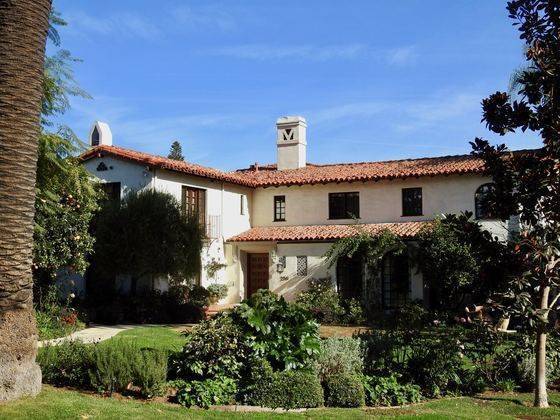
The founding stock is Mediterranean by disposition. The Alphabet Streets went up as modest cottages and bungalows on lots mostly between 5,200 and 7,200 square feet. The Riviera drew Spanish Colonial Revival and traditional houses onto deeper parcels around the golf course, its streets named Amalfi, Capri, San Remo and Sorrento. Huntington Palisades wrote its character into the deeds, with minimum construction budgets, a bar on commercial use and a two-story cap, then set those houses along curved streets and planted parkways. At Castellammare, Alphonzo Bell terraced an Italian hill town onto a coastal slope, stitched together by public stairways, with the Bel-Air Bay Club opening just up the shore in 1927.
The mid-century layer is small in number and outsized in influence. Charles and Ray Eames completed Case Study House 8 at 203 Chautauqua Boulevard in 1949, the Eames House, a National Historic Landmark since 2006; Case Study House 9, the Entenza House designed with Eero Saarinen for Arts and Architecture editor John Entenza, stands next door. Both came through January 2025, and the Eames House reopened in July 2025 after restoration, with the studio shown publicly for the first time. Rustic Canyon meanwhile accumulated work by Lloyd Wright, Richard Neutra, Craig Ellwood and Ray Kappe among the old Uplifters cabins, while Marquez Knolls and the Highlands added postwar ranch and canyon contemporary.
What gets built now is governed by fire performance. All of Pacific Palisades sits in a Very High Fire Hazard Severity Zone, so new and substantially remodeled homes must meet California's Chapter 7A ignition-resistant standards: Class A roof assemblies, ember-resistant vents, enclosed eaves, tempered or multi-pane glazing and rated exterior materials, alongside annual brush clearance. Post-fire executive orders created a streamlined path for like-for-like rebuilds up to roughly ten percent larger than the prior structure, with departures from that envelope returning to standard review. A statewide Zone 0 rule for the first five feet around a structure remained in rulemaking through 2026, with the Board of Forestry circulating draft regulations, so treat the near-house zone as unsettled.
Understanding the Market
Relative pricing across the Palisades has long followed lot and setting more than square footage. The Riviera sits at the top on the strength of roughly seven hundred homes on larger-than-typical parcels near the country club. Huntington Palisades follows, prized for flat, wide bluff-top lots and walkability to the village. The Alphabet Streets trade a step down on compact grid lots, Castellammare varies sharply with slope, view and access, and the Highlands, where townhomes and condominiums sit alongside houses, remains the most attainable entry to Pacific Palisades real estate. One widely cited aggregator put the typical Palisades home value near three million dollars in mid-2026, down about ten percent year over year; treat that as directional only.
Since the fire, the market has priced land and finished houses as two different products. Local tracking compiled by PaliBuilds and published by the Palisadian-Post counted 586 lot sales in the eighteen months after January 2025, with 2025 lot trades reported near an average of $2.1 million and roughly two-thirds of buyers described as intended owner-occupants rather than investors. Rebuild economics turn on what transfers with the dirt: a certified-cleared lot, a lot carrying an approved plan set and issued permit, and a completed new house each carry different timelines and risk. Permit counts vary by source and counting method, so confirm any parcel's actual status in the city record rather than by neighborhood reputation.
Insurance now sets the pace of many transactions. The California FAIR Plan, the state's insurer of last resort, caps residential dwelling coverage at $3.3 million and reported 668,609 policies in force in December 2025, a 146 percent increase since September 2022, against roughly $724 billion of exposure. It handled about 5,400 claims from the January 2025 fires and paid nearly $3.5 billion, and in February 2025 it was authorized to assess member insurers $1 billion. Many Palisades owners now pair a FAIR Plan policy with a wrap-around difference-in-conditions policy. Practical guidance for anyone shopping Pacific Palisades homes for sale: get written quotes inside your inspection contingency, not at the end of escrow.
Micro Neighborhoods
Laid out in the mid-1920s after the Los Angeles Athletic Club assembled land above Santa Monica Canyon, the Riviera wraps George C. Thomas Jr.'s championship course, which opened for play in the winter of 1926 to 1927. Streets carry Italian coastal names, among them Amalfi, Capri, San Remo, Monaco and Sorrento, and roughly seven hundred homes sit on parcels deeper than the Palisades norm, split by Sunset Boulevard into an upper canyon side and a lower side near the club. January 2025 affected the neighborhood unevenly, block by block, and the club itself survived. Verify any specific parcel through records rather than street-level assumptions.
View The RivieraThe 1926 bluff-top tract between the village and Potrero Canyon, subdivided by Robert C. Gillis's Santa Monica Land and Water Company on 226 acres bought from Collis Huntington's heirs. An Olmsted-influenced plan gave it curved streets, planted parkways and Mexican place names such as Chapala, Toyopa, Alma Real and Ocampo, with about five hundred homes on wide, flat lots. Deed restrictions and the Huntington Palisades Property Owners Corporation still shape the streetscape. Losses here were extensive in January 2025 and rebuilding is visible throughout. Flat pads simplify construction, though bluff-edge parcels warrant geologic review and parts of the tract fall inside the California Coastal Zone.
View Huntington PalisadesWhere the town began. The Pacific Palisades Association platted this grid in 1921 and 1922, naming streets alphabetically for church figures: Albright, Bashford, Carey, Embury, Fiske, Galloway, Hartzell, Iliff, Kagawa. Lots mostly run 5,200 to 7,200 square feet, and roughly 880 residences stood here before January 2025, a mix of surviving 1920s bungalows, midcentury remodels and recent two-story construction. Losses north of Sunset Boulevard were near total, and the grid has since led Palisades permit activity, with foundations, framing and finished houses now visible block by block. Flat lots, no homeowners association and adjacency to Swarthmore and Palisades Village keep demand concentrated here.
View The Alphabet StreetsA master-planned canyon community up Palisades Drive, begun in 1966 by developer W. Charles Chastain after he donated roughly 1,500 acres to parkland, with the first homes selling in 1971 and phases continuing into the late 1990s. About 1,800 houses, townhomes and condominiums make up the neighborhood, several enclaves guard-gated, most carrying association dues and design review. Topanga State Park wraps the streets. Most homes survived January 2025, though losses occurred near open-space edges and many houses required smoke remediation. Palisades Drive is the single public road in and out, a fact worth weighing in evacuation planning, insurance pricing and daily driving.
View Palisades HighlandsAlphonzo Bell's seaside sequel to Bel-Air, subdivided in the mid-1920s on the steep coastal slope at the Palisades' western edge and named for Castellammare di Stabia on the Bay of Naples. Italian-named lanes including Posetano, Tramonto, Revello and Porto Marina are linked by public stairways, and the housing spans 1920s villas, midcentury slope houses and contemporary homes engineered on caissons. The Getty Villa occupies the canyon alongside. Slide history here is a matter of public record and Caltrans maintains work on the Tramonto and Castellammare slide areas, so a parcel-specific geotechnical report belongs in every purchase. The tract lies within the California Coastal Zone.
View CastellammareNot a subdivision but the town's center of gravity: the Swarthmore Avenue business district, the Palisades Recreation Center on Alma Real, the branch library site, and the open-air Palisades Village retail center, which reopened on August 15, 2026 with more than forty shops and restaurants and the Bay Theater. South of it the bluffs fall away to Pacific Coast Highway, with George Wolfberg Park at Potrero Canyon, opened in 2022, linking the recreation center area toward the beach. Housing near the village skews to the Alphabet Streets and Huntington Palisades; the draw is walkability, rare on this stretch of the Westside.
A postwar hillside tract built out through the 1950s and 1960s on land once part of Rancho Boca de Santa Monica, the Marquez family grant that gave the neighborhood and its elementary school their name. The stock began as single-story ranch houses on view lots stepping toward the ocean, many since expanded or replaced, on streets between Sunset Boulevard and the canyons at the Palisades' western side. The area was among the harder hit in January 2025, and rebuilding is under way alongside intact homes. Marquez Charter Elementary returned to its site in temporary classrooms in September 2025 while a full rebuild proceeds toward a 2028 target.
Condominiums
Education
Assignment follows the parcel and several local campuses are operating from interim sites during rebuilding, so confirm both the boundary and the physical campus with LAUSD or the school before relying on either.
Common Questions
Keep Exploring
Deciding between them? Read Brentwood vs Pacific Palisades.
Work With Ben
Coastal inventory rewards patience and relationships. Tell Ben what you are looking for and hear about the quiet ones, including off market.
Start the ConversationBen will reach out shortly to set up your tour.