Home / Neighborhoods / Carbon Beach
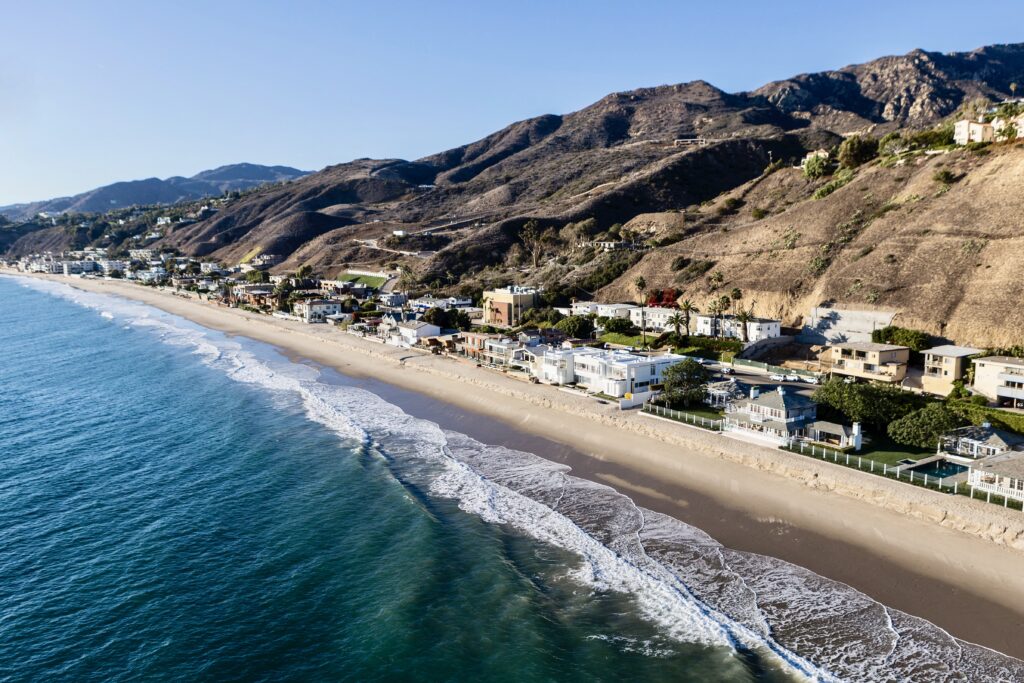
A mile and a half of sand running east from the Malibu Pier, the stretch the press has long called Billionaire's Beach.
About the Neighborhood
Carbon Beach is the run of sand immediately east of the Malibu Pier, described by the California Coastal Commission as a generally wide sandy beach about a mile and a half long with private residences lining it. It takes its name from Carbon Canyon, the drainage that reaches the shore at its eastern end, and it has been called Billionaire's Beach in the press for decades because of the concentration of ownership rather than because of any formal designation. Carbon Beach homes for sale are among the most closely watched properties in Los Angeles, and among the least publicly marketed.
The stretch is small. The Real Deal, reporting in 2017, described roughly seventy houses on the beach and noted that Larry Ellison alone was then tied to at least nine of them, alongside his acquisition of the former Casa Malibu Inn, since reopened as a Japanese-style hotel. That density is the market's defining fact: when a handful of owners control a meaningful share of an already short row, supply is governed by private decisions rather than by listing cycles, and a single trade can reset expectations for the whole beach.
It is also the most legally documented beach in Malibu, because of a long public-access fight that buyers should understand rather than avoid. Two accessways now serve the stretch. The Zonker Harris Accessway at 22664 Pacific Coast Highway, named for a Doonesbury character and in place since the 1980s, sits toward the pier end. A second path at 22132 Pacific Coast Highway opened on 31 May 2005 and is managed by the Mountains Recreation and Conservation Authority, with gates that open at sunrise and close at sunset. A third, Carbon Beach West, followed in 2015.
The location is the other half of the value. Carbon Beach begins where Malibu's commercial centre is, which means the pier, restaurants, the hotel and the Civic Center are a walk or a short drive rather than a coastal expedition, and Santa Monica is roughly twenty minutes down Pacific Coast Highway in ordinary traffic. The beach faces south and sits reasonably protected within Santa Monica Bay, so the water is calmer here than on the exposed western beaches. For buyers weighing Malibu beachfront homes for sale, that combination of proximity and orientation is what distinguishes Carbon.
Diligence is unusually specific. Confirm whether the parcel carries a recorded lateral or vertical access easement and exactly where it runs, since easements here were imposed as permit conditions over five decades and several were litigated. Obtain a State Lands Commission determination of the boundary between private land and public trust land, a wave uprush report, and the full permit history of any seawall, bulkhead or caisson foundation. Then verify the onsite wastewater system and read the coastal permit file for unpermitted work, which is the most common cause of a stalled remodel on this beach.
Life Here
Value on Carbon is counted in linear feet on the sand, then in orientation and set-back depth. Roughly seventy houses share the stretch, so the difference between forty feet of frontage and eighty is not incremental. Houses present a closed face to Pacific Coast Highway and open almost entirely to the water.
The Malibu Pier, the Civic Center, the hotel and the restaurants sit at the western end, so errands and dinner do not require a drive up the coast, and Santa Monica is about twenty minutes east in ordinary traffic. It is the most connected beachfront address in Malibu.
Two accessways cross the row: the Zonker Harris Accessway near the pier end, in place since the 1980s, and the path at 22132 Pacific Coast Highway opened in 2005 under state agency management, with a third opened in 2015. Below the mean high tide line the beach is public, as it is everywhere in California.
History
Carbon Beach takes its name from Carbon Canyon, the watershed that meets the ocean at the eastern end of the stretch and that served as a boundary marker for one of May Rindge's earliest subdivisions around 1926. The beach itself was built out later than the Colony, largely from the middle of the twentieth century, as Pacific Coast Highway matured into a year-round route and beach houses stopped being seasonal. Its proximity to the Malibu Pier, which anchored the town's commercial life, made this the coast's most convenient beachfront long before it became its most expensive.
The public-access story begins with the Coastal Act of 1976, which allowed permits for shoreline development to be conditioned on the dedication of public access. Along Carbon Beach those conditions accumulated over decades, in the form of lateral easements across dry sand and a small number of vertical paths from the highway to the water. The Zonker Harris Accessway, named after a Doonesbury character and operated by Los Angeles County, has served the western end since the 1980s. Many other dedications were recorded but never opened, which set up the litigation that followed.
The best-known case is David Geffen's. He agreed in 1983 to build a public walkway as a condition of expanding his house, then declined to open it; he and the City of Malibu sued the Coastal Commission in 2002, and after settlement the nine-foot path opened in April 2005 with roughly $300,000 in reported legal fees paid. A second fight, over an easement associated with the Ackerberg property at 22466 Pacific Coast Highway, produced a 2009 Coastal Commission cease and desist order, an appellate ruling in 2012 and the Carbon Beach West accessway, dedicated in July 2015.
Architecture
Carbon Beach houses are shaped by a hard set of constraints: a narrow parcel caught between a state highway and the ocean, a required setback from wave action, neighbours on both sides and a coastal permit process that reviews almost everything. The result is a consistent type. The highway elevation is effectively a wall, usually a gate, a garage door and planting, giving nothing away to the traffic passing a few feet from the front door. The ocean elevation is almost entirely glass, stepped in decks, with the principal rooms lifted above the sand and the foundations carried on caissons or piles behind a bulkhead or rock revetment.
Within that type there is real range. Several mid-century houses survive in altered form, their low horizontal lines still legible behind later additions; the 1980s and 1990s produced tall, gabled beach houses with levels stacked to capture the most out of limited frontage; and the past two decades have brought architect-led rebuilds in glass, board-formed concrete, teak and lime plaster, often with rooftop terraces, subterranean garages and screening rooms buried where daylight is not needed anyway. Because the lots are small and the frontage is fixed, the ambitious houses on this beach go down and up rather than out.
The engineering matters more than the finishes. Shoreline protection is regulated rather than assumed: any new bulkhead or seawall requires a coastal engineer's wave uprush analysis and approval from the city or the Coastal Commission, and existing structures carry permit histories that determine what may be repaired, what may be replaced and what must simply be left alone. Caisson condition, deck framing, salt corrosion and drainage are the routine failure points, and on this beach they are also negotiating points, since the cost of remediating a compromised foundation or an unpermitted seawall is not a marginal number at any price level.
Understanding the Market
Carbon Beach is the shortest trophy market in Los Angeles. Roughly seventy houses share the stretch, and The Real Deal's 2017 reporting that Larry Ellison was already tied to at least nine of them illustrates how a small number of holders can absorb supply for years at a time. Individual documented trades have been substantial: the same reporting put his purchase of the Ackerberg house at 22466 Pacific Coast Highway at $48 million. Figures like these are useful as context for scale, not as comparables for any particular parcel today.
Because the row is short and the buyers are few, pricing is driven by frontage and by scarcity rather than by any neighbourhood average. Two houses with similar interiors and similar square footage can diverge sharply on linear feet of sand, orientation, the depth of beach in front of the seawall and whether a recorded lateral easement crosses what an owner would otherwise treat as private deck. Condition of the foundation and the shoreline protection is the other lever, and it is the one that most often moves a number after inspections rather than before them.
Marketing is deliberately quiet. Owners on this beach do not generally want signage, open houses or a public price history, so a significant share of what trades moves through private conversations between a small circle of agents and existing owners, some of whom are looking to add to a holding rather than to buy a first house on the sand. For a buyer, being credible and pre-positioned matters far more than being fast, because there is rarely a race to a deadline. Anyone seriously shopping Malibu beachfront homes for sale here should expect to be introduced rather than to browse.
Micro Neighborhoods
The western end of Carbon Beach sits directly beside the Malibu Pier, the hotel and restaurants, and the Civic Center, which makes it the most walkable beachfront in Malibu and the easiest commute toward Santa Monica. The Zonker Harris Accessway at 22664 Pacific Coast Highway, in place since the 1980s and operated by Los Angeles County, brings public arrivals onto the sand at this end. Houses here trade convenience and activity for solitude, and buyers who want quiet sand generally look further east along the row.
The centre of the beach is the densest concentration of trophy houses, and it is where the accessway at 22132 Pacific Coast Highway opened in May 2005 after the litigation surrounding the Geffen dedication. It is managed by the Mountains Recreation and Conservation Authority with gates that open at sunrise and close at sunset. Frontage here tends to be wider than at the ends, sand is generally deeper, and several parcels have been assembled or rebuilt in the past two decades by owners who already held property on the beach.
The eastern end of the beach runs toward Carbon Canyon, the drainage that gives the stretch its name and that was used as a subdivision boundary in the 1920s. The canyon's open space was added to the Santa Monica Mountains National Recreation Area in 2020. Houses at this end sit further from the pier and the restaurants and closer to the canyon mouth, which affects both privacy and sand behaviour, since creek outflow and seasonal storms move the beach profile more noticeably at drainage points.
Across Pacific Coast Highway, Carbon Mesa Road climbs into the hillside above the beach, offering a different product entirely: land, gardens, parking and elevated views down the coast, without the maintenance and exposure of a structure on the sand. Buyers who want the Carbon location and the view but not the surf-line engineering shop this side, and owners on the beach sometimes buy here for staff, guests or garaging. Hillside grading and geotechnical rules apply to most of these parcels.
Immediately west, past the pier and Malibu Lagoon, Malibu Colony offers the same coast under a different structure: a guarded private road, a genuine street of neighbours and lots about thirty feet wide. Carbon buyers weighing the two usually decide between the Colony's gate and community and Carbon's larger, ungated parcels and proximity to town. Prices and marketing behaviour differ accordingly, and it is common for a buyer to shop both rows at once before committing to one side of the lagoon.
View West to the ColonyEducation
Malibu's public campuses currently belong to Santa Monica-Malibu Unified, with separation agreements toward a Malibu district approved in late 2025 and state steps still pending; assignment follows the individual parcel, so confirm the exact address with the district and confirm admissions directly with any private school.
Common Questions
Work With Ben
Almost nothing on this beach is marketed conventionally, and much of it moves between owners who already hold houses here. Tell Ben what frontage you need and he will work the block privately, including off-market inventory, and pull the coastal and easement file before you tour.
Start the ConversationBen will reach out shortly to set up your tour.