Home / Neighborhoods / Serra Retreat
A gated canyon enclave of roughly ninety-six lots above Malibu Creek, minutes on foot from the Civic Center.
About the Neighborhood
Serra Retreat occupies lower Malibu Canyon, on the rising ground east of Malibu Creek and directly behind the Civic Center. The City of Malibu's own local coastal program neighborhood descriptions put it at approximately ninety-six lots ranging from under half an acre to about four acres, with eighty percent of them an acre or less, reached by a privately maintained country road and described in that document as part of Malibu's historic ranch center with a rural character. Two guarded entries are commonly cited, one on Cross Creek Road and one from Pacific Coast Highway. Buyers researching gated communities in Malibu almost always end up here at some point, because there is nothing else quite like it.
The name comes from the hill above. Serra Retreat is a Franciscan retreat center on twenty-six wooded acres at 3401 Serra Road, built on the site of May Rindge's unfinished fifty-room castle and rebuilt after fire in 1970. The residential enclave grew up around and below it over the following decades, which is why the streets curve the way they do and why the setting reads as grounds rather than as a subdivision. Sycamores and eucalyptus shade much of the road network, the creek runs along the western edge, and the canyon walls rise to the north. Ocean views open from the higher parcels and from Sweetwater Mesa Road above, while creek-side lots trade outlook for flat, usable land.
That adjacency is the enclave's central appeal. Malibu Creek reaches the sea at Malibu Lagoon just west, with Surfrider Beach, the Adamson House and Malibu Lagoon State Beach immediately beyond, and the Civic Center's markets, restaurants and shops at Cross Creek are within an easy walk or bicycle ride for much of the neighborhood. Malibu Canyon Road climbs north from the gate toward Calabasas and the 101, which makes this one of the few Malibu addresses with a genuine inland route as well as a coastal one. Buyers looking at Serra Retreat Malibu are generally trading beach frontage for privacy, mature landscape, land and everyday convenience.
The enclave's recent record is candid about canyon living. The Franklin Fire, which began on Malibu Canyon Road in December 2024 and burned more than four thousand acres, reached Serra Retreat and destroyed structures inside the gates; fire officials characterized losses across the fire as limited, at roughly twenty structures, but the neighborhood was directly in its path. Two months later, in February 2025, storm runoff off the fresh burn scar pushed debris and boulders reported at around five hundred pounds across Cross Creek Road, Palm Canyon Lane and the northerly section of Serra Road, and county crews evacuated residents who could not drive out. Both events are part of the honest picture.
Diligence follows directly from that. Because the roads are privately owned, the city does not clear them, and cleanup and repair fall to the owners' association, so ask for its governing documents, reserve position and recent assessment history before you commit. Confirm flood mapping and creek proximity for the specific parcel. Confirm the septic system's capacity, condition and permit status, and follow the city's Civic Center wastewater program, which as of 2026 places Serra Retreat in later-phase planning rather than near-term construction. Get real insurance quotes inside your contingency period. From October through January, wind season keeps brush clearance and evacuation planning part of ordinary household routine here.
Life Here
Two guarded entries and a network of privately maintained roads keep the enclave quiet, with the tradeoff that upkeep and storm cleanup belong to the owners rather than the city.
Malibu Creek runs the western edge on its way to the lagoon, and the canyon walls climb north, giving the neighborhood a wooded interior landscape rare this close to the ocean.
The Civic Center's markets, restaurants and shops sit a short walk or bicycle ride from much of the enclave, with Surfrider Beach and Malibu Lagoon just past them.
History
The hill above the neighborhood carries Malibu's most famous unfinished building. May Rindge, widow of Frederick Rindge and holder of the Rancho Topanga Malibu Sequit land grant, began a fifty-room mansion on the rise then known as Laudamus Hill around 1928 to 1929, intending it as the jewel of the West Coast; accounts put the sum spent between 1929 and 1932 near half a million dollars. The money ran out, the house was boarded up in 1932, and it was never inhabited. Rindge died in 1941 with the shell still standing above Malibu Creek, an unusually literal monument to the end of the ranch era on this coast.
In May 1942 the Franciscan Friars of the Santa Barbara Province bought the twenty-six-acre property and the unfinished mansion for a reported $50,000. The original intent was a seminary; within about a year the friars had repurposed the buildings as a retreat house instead, naming it for Junipero Serra. Between 1942 and 1970 the retreat hosted thousands of guests, initially men and later women as well, and the Rindge shell finally served a purpose. Houses began appearing on the slopes below and around the grounds over the same decades, which is how a Catholic retreat came to lend its name to a residential enclave.
A Santa Ana-driven firestorm swept through Malibu Canyon in 1970 and burned the mansion to the ground, leaving charred debris and twisted steel. The Franciscans rebuilt incrementally rather than all at once: an administration building rose over the original basement, the 1962 Holy Family building had survived, and a new dining room and kitchen followed in 1982. The rebuilt center reads as Mediterranean, with roughly sixty guest rooms, a chapel and terraced gardens on the wooded knoll. The friars have periodically lobbied to see the surrounding neighborhood called Serra Canyon instead, to reduce confusion between the retreat and the residential streets that borrowed its name.
Architecture
The land plan came from topography and history rather than from a developer's grid. The city's own local coastal program describes roughly ninety-six lots running from under half an acre to about four acres, with eighty percent an acre or less, on a privately maintained country road through what the same document calls Malibu's historic ranch center. Streets follow the contours of lower Malibu Canyon and the creek's alignment instead of cutting across them, so parcels vary in shape, orientation and grade. That irregularity is the enclave's signature: two adjacent lots can differ substantially in usable pad, tree cover, privacy and outlook, which makes site-specific evaluation essential.
Style is deliberately unregimented. The city's description notes single-family residences from small to large reflecting a genuine mix of scale and architecture, and that remains accurate: postwar canyon houses, Spanish and Mediterranean work echoing the retreat's own rebuilt idiom, ranch houses on the flatter creek-side parcels, and contemporary construction on the view lots. Some parcels carry equestrian history. Above the enclave, Sweetwater Mesa Road holds larger estate sites with broader ocean exposure. The absence of a uniform architectural language is part of why the neighborhood reads as accumulated over eighty years rather than delivered at once.
Constraints shape what can be built more than taste does. Every parcel sits in the coastal zone under Malibu's local coastal program, so additions and new construction run through coastal development permitting. Septic capacity effectively caps bedroom count and house size on most lots, since the enclave is on onsite wastewater treatment. The entire city is designated a Very High Fire Hazard Severity Zone, which brings ignition-resistant construction standards, defensible space and brush clearance requirements. Creek setbacks, sensitive habitat considerations and canyon grading rules apply on many parcels. Verify the buildable envelope with an architect or permit expediter before assuming any specific program is achievable.
Understanding the Market
Serra Retreat trades on a combination almost nothing else in Malibu offers: a guarded gate, an acre or so of wooded canyon land, and a walk or short bicycle ride to the Civic Center, the lagoon and Surfrider Beach. That is a different proposition from beachfront Malibu, where the sand comes with revetments, tideline easements and coastal engineering. Within the enclave, pricing sorts by elevation and outlook first, with ocean-view parcels and the Sweetwater Mesa slopes above at the top, then by lot size and usable flat pad, then by house condition. Creek-side lots compete on mature landscape and convenience rather than view.
The market here is diligence-driven and correspondingly slower than its size would suggest. Insurance is the item most likely to determine whether a deal closes, and buyers should obtain real quotes inside the contingency period rather than assume availability; many Malibu owners now combine a California FAIR Plan policy with wrap-around coverage. Beyond that, the private road association's obligations, septic capacity and permit status, flood and creek mapping, and any open coastal permits all need written answers. Escrows commonly extend to accommodate that work, and experienced local agents treat the longer timeline as ordinary practice rather than as a sign of trouble.
The Franklin Fire and the storm season that followed have made the recent inventory unusually varied. Intact period houses, recent contemporary builds and rebuilding parcels can sit within a few hundred yards of one another, and they do not price on the same fundamentals. For a lot or an in-progress rebuild, confirm debris clearance, whether plans and permits transfer with the sale, utility restoration status on the street and the association's position on construction access, which matters more on private roads than on public ones. Serra Retreat homes for sale should be assessed parcel by parcel; neighborhood generalizations do not survive contact with the title report.
Micro Neighborhoods
Serra Road climbs toward the twenty-six-acre Franciscan retreat that gives the neighborhood its name, and the parcels along it inherit the setting: mature sycamores and eucalyptus, terraced ground, and outlook that improves steadily with elevation. This is where canyon and ocean views open up and where houses tend toward larger scale. It is also the section most exposed to canyon weather, and the northerly stretch was among the streets blocked by debris after the February 2025 storms. Buyers who want the enclave's most dramatic siting generally end up looking here first.
The eastern gate area, at the corner of Cross Creek Road and Palm Canyon Lane, is the enclave's front door and its most convenient quarter. Parcels here sit lower and flatter, closer to Malibu Creek and within a genuine walk of the Civic Center's markets and restaurants. Trees are mature, land tends to be usable rather than steep, and views are foreground rather than panoramic. The tradeoff is proximity to the creek and to the canyon's drainage path, which makes flood mapping and drainage history a first-order question on these specific lots.
Above and behind the gates, Sweetwater Mesa Road holds the largest and highest parcels associated with the area, with broad Pacific exposure and estate-scale sites rather than the enclave's more typical acre lots. Character here is closer to a Malibu ridge address than to the wooded canyon floor below, with longer driveways, more grading and more ambitious construction. It is also further from the Civic Center on foot, so the walkability that defines lower Serra Retreat largely gives way to driving. Buyers weighing view against convenience often decide the question on this road.
Immediately outside the gates lies Malibu's closest thing to a downtown: the Civic Center, with Cross Creek's courtyard shopping, markets, restaurants and civic offices, plus the Adamson House, Malibu Lagoon State Beach and Surfrider Beach just beyond. This is the reason Serra Retreat functions as a walkable address rather than an isolated canyon one. It is also the area governed by the city's Civic Center wastewater program, so the phasing and deadlines attached to septic systems in and around the enclave are worth tracking through city and regional board records.
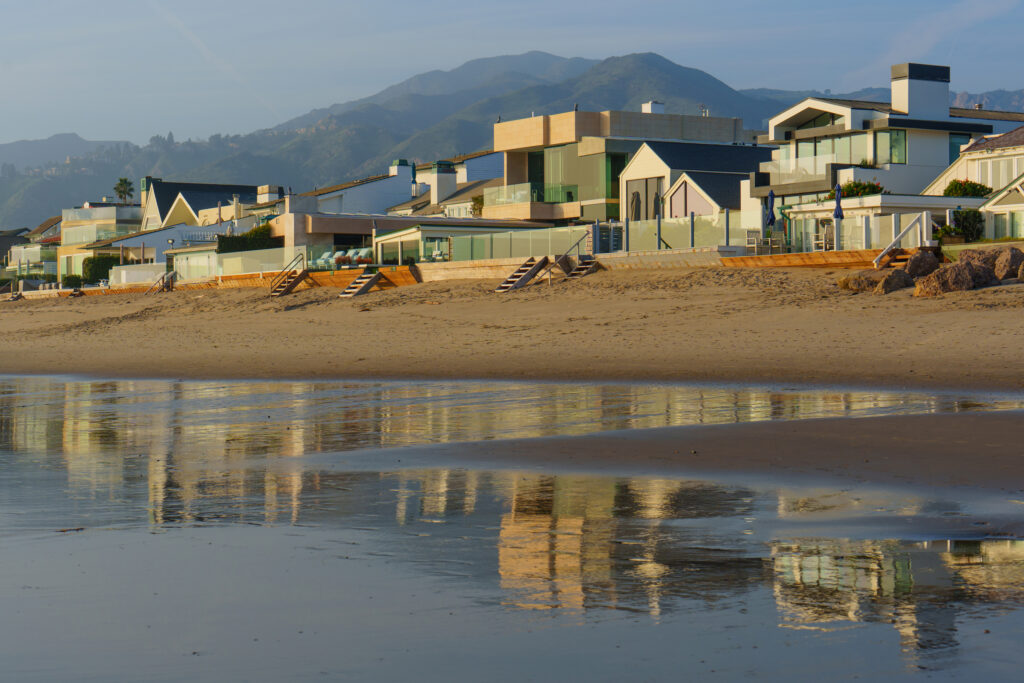
West across Malibu Creek and the lagoon, Malibu Colony offers the gated-community alternative in its beachfront form: the coast's original private row, tight to the sand, with a guarded entry and a much smaller land component. Buyers regularly compare the two because both answer the same instinct for privacy in different currencies, one in ocean frontage and one in canyon acreage. Serra Retreat gives land, trees and a shorter list of coastal engineering questions; the Colony gives the water at your door. Touring both in a single afternoon usually settles the matter quickly.
View Malibu Colony, Across the LagoonEducation
All four public campuses currently belong to Santa Monica-Malibu Unified; separation agreements for an independent Malibu district were approved in December 2025 with state-level steps outstanding and a separation window reported for 2027 to 2029. Assignment follows the individual parcel, so confirm any specific address with the district before relying on it.
Common Questions
Work With Ben
Tell me whether you want creek-side flat land or an up-canyon view parcel, and I will track Serra Retreat listings for you, including homes that trade off market. On private roads with a shared association and a real fire and storm history, early guidance saves months.
Start the ConversationBen will reach out shortly to set up your tour.