Home / Neighborhoods / Point Dume
A mesa of acre lots and bluff streets on the headland between Zuma and Paradise Cove, where beach keys, horse zoning and a state preserve share one address.
About the Neighborhood
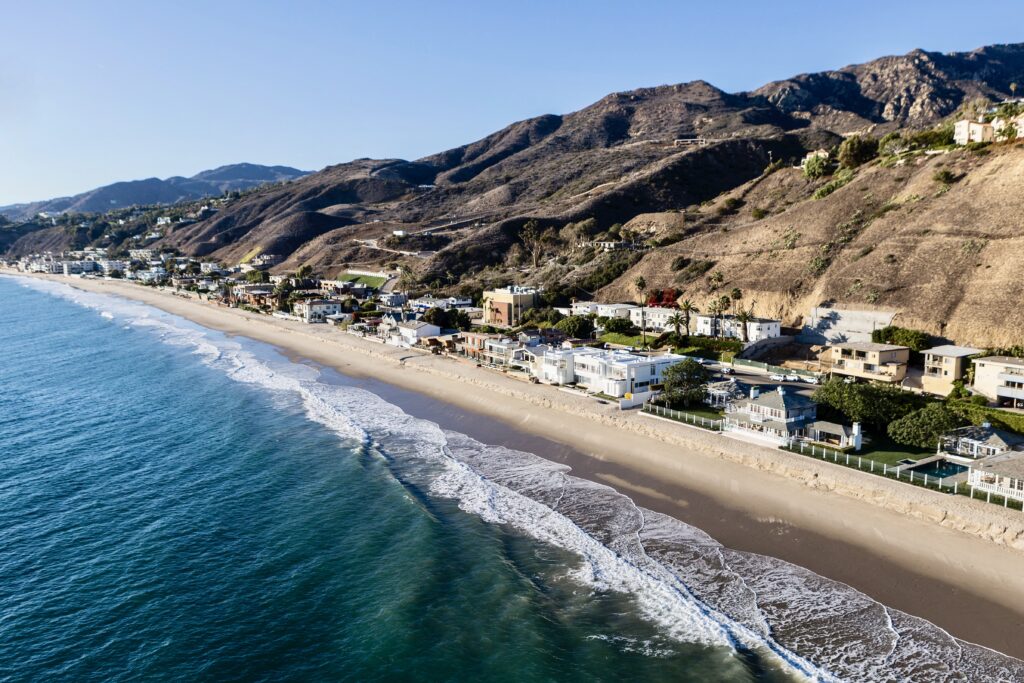
Point Dume is the headland that closes the north end of Santa Monica Bay, and the mesa behind it is one of the few places in Malibu where the land is wide enough to live on rather than merely perch. Streets run in a loose grid across the plateau, most lots start near half an acre and many run to an acre or more, and the ocean appears at the ends of streets rather than through every window. Buyers searching Point Dume homes for sale are usually choosing between three things at once: land, a bluff view, and whether the parcel carries deeded access to the sand below.
The name is older than the neighborhood. George Vancouver charted the promontory in 1793 and named it for Padre Francisco Dumetz of Mission San Buenaventura; the shortened spelling entered the record through a mapping error and was never corrected. California State Parks holds the headland itself as Point Dume State Beach, including the Point Dume Natural Preserve, where a short trail climbs to a bluff overlook used for gray whale watching from December into April. Los Angeles County operates Westward Beach at the foot of the point and Zuma Beach to the northwest, which is why the mesa lives between a state preserve and a county shoreline.
Zoning explains the character. Much of the mesa sits under the city's Rural Residential districts, which are written for large-lot single-family development with agricultural and animal keeping on qualifying parcels, in minimum-parcel tiers running from one acre to twenty. In practice that means arenas and paddocks a block from the water, hedges instead of walls, and a street pattern with almost no through traffic. Point Dume Malibu real estate consequently includes 1950s and 1960s ranch houses on flat pads, replacement contemporaries behind the same hedges, and a small number of bluff parcels where the lot, not the house, is the asset.
Then there are the beach keys, which are the neighborhood's most misunderstood feature. Local brokerage guides consistently describe three deeded groups, commonly written as Riviera I, II and III, tied to mid-century subdivision tracts rather than to where a house happens to sit: Riviera I around Zumirez Drive with a drive-down gate, Riviera II on the interior streets with a walking path to the middle of Little Dume, and Riviera III on parts of Cliffside and Dume Drive with stairs to the rockier western end. Because the right runs with the tract, it must be confirmed in title, not assumed from the view.
The sand below is public in the way all California beaches are public. Little Dume has no direct public entrance at Whitesands Place, but it can be reached on foot below the mean high tide line from Point Dume State Beach or from Paradise Cove, roughly a mile and four-fifths of a mile respectively, and both routes can close at high tide. Anyone buying here should read the coastal file rather than the marketing: bluff setback and geotechnical findings, the septic system's permitted capacity, recorded access easements, and the parcel's fire history. Escrows on the mesa are longer than city escrows for exactly these reasons.
Life Here
State Parks holds the point and its natural preserve, with a bluff trail and an overlook used for gray whale watching from December into April. Los Angeles County runs Westward Beach at the base of the headland and Zuma just northwest, 1.8 miles of shoreline with about two thousand parking spaces across eight lots.
Rural Residential zoning on the mesa is written for large lots and animal keeping on qualifying parcels, which is why arenas, paddocks and orchards sit within a few blocks of the water. Half-acre and acre-plus parcels are the norm, and hedges rather than gates do most of the work of privacy.
Deeded access to Little Dume follows subdivision tracts, not sight lines. Local guides describe three groups with different arrivals: a drive-down gate off Zumirez, a walking path from the interior streets, and stairs down toward the rocky western end. The right is a title matter and should be confirmed in escrow.
History
Vancouver named the promontory in 1793 for Padre Francisco Dumetz of Mission San Buenaventura, and the truncated spelling that reached the charts stuck. For the following century the point was ranch land, part of the Rancho Topanga Malibu Sequit holding that Frederick and May Rindge assembled from 1892 onward and defended against public roads until the state opened the Roosevelt Highway in 1929. Only after the highway and the eventual breakup of the Rindge holdings did the mesa become reachable enough to subdivide, which is why almost nothing here predates the middle of the twentieth century.
Subdivision arrived in stages after the Second World War, producing the tract lines that still govern beach access today. Local guides trace the Riviera designations to mid-century subdivisions whose recorded easements gave particular tracts a gate onto Little Dume, which is why the right follows a parcel's tract rather than its distance from the water. Postwar buyers were not chasing trophies; they were buying cheap, windswept, treeless acreage with a view, and they planted the cypress and eucalyptus windbreaks that now read as mature landscape. The result was a coastal neighborhood built like a rural one, with paddocks, orchards and workshops behind houses that turned their backs to the highway.
Modern Point Dume has been shaped as much by protection as by construction. State Parks holds the headland and its natural preserve; the surrounding water is regulated as the Point Dume State Marine Reserve and Conservation Area; and the whole mesa sits inside the coastal zone, where the city issues permits under a Local Coastal Program certified in 2002. The November 2018 Woolsey fire, which destroyed 473 single-family homes inside Malibu city limits, reached this part of the coast and losses varied street by street, so parcel records rather than neighborhood generalisations should settle any question about a specific address.
Architecture
The mesa's base layer is the postwar ranch house: single story, low pitched roof, glass toward the ocean, garage toward the street, set well back on a flat pad. These houses were built for wind and salt rather than for display, and many survive with their proportions intact behind hedges that have grown taller than the buildings. Their virtue for today's buyer is the pad itself, since a level acre with mature planting and an existing septic footprint is worth more than the structure standing on it in most Point Dume transactions.
The second layer is the architect-built coastal modern that Malibu produced steadily from the 1960s onward: steel and glass pavilions, board-formed concrete, courtyard plans that turn their backs to the road and open to a lawn and the water. Point Dume rewarded that approach because the lots are wide enough to organise a house around outdoor rooms rather than around a single view window. Bluff parcels along Cliffside and Birdview take the idea further, with long horizontal glass lines set behind the required bluff setback rather than at the edge.
The current layer is replacement construction, generally in a restrained, warm modern idiom: white or lime-washed volumes, wood soffits, folding glass, pools set into the lawn and detached studios or guest units where zoning allows. Rebuilds here are governed less by style than by process, since a new house triggers a coastal development permit, geotechnical review, biological and drainage plans and an onsite wastewater design. That is why so many mesa projects read as thoughtful and slow rather than speculative, and why finished ones command a premium over comparable lots.
Understanding the Market
Point Dume trades on a short list of variables: how much flat, usable land the parcel holds; whether the view is a whitewater view or a filtered one; and whether the deed carries a Little Dume key. Brokerage guides commonly cite a meaningful premium for key-carrying parcels over otherwise comparable houses on the same block, a figure that is discussed openly in the market but is not a published statistic, so treat it as directional rather than fixed. The mesa's supply is small and turnover is slow, which sharpens all three variables.
The neighbourhood sits in a different lane from Malibu's pure beachfront rows. A buyer choosing Point Dume over Carbon Beach or the Colony is trading direct sand frontage for acreage, privacy, quiet streets and a school on the mesa, usually at a lower price per square foot of house. The trade runs the other way for anyone whose priority is linear feet on the water. Adjacent trophy activity does spill over: the bluff compound above Paradise Cove that Marc Andreessen bought in 2021 was widely reported at $177 million, then a California record.
Practically, the market here moves through relationships. Many mesa houses sell quietly among neighbours, architects and a handful of local agents before they are ever photographed, and the sellers are often long-tenured owners deciding whether to rebuild or move on. Buyers who want a genuine choice of Point Dume homes for sale should be positioned before the listing exists, with proof of funds ready, a geotechnical consultant identified and an insurance broker already engaged, because on this mesa the diligence period rather than the opening price is usually what decides whether a deal closes at all.
Micro Neighborhoods
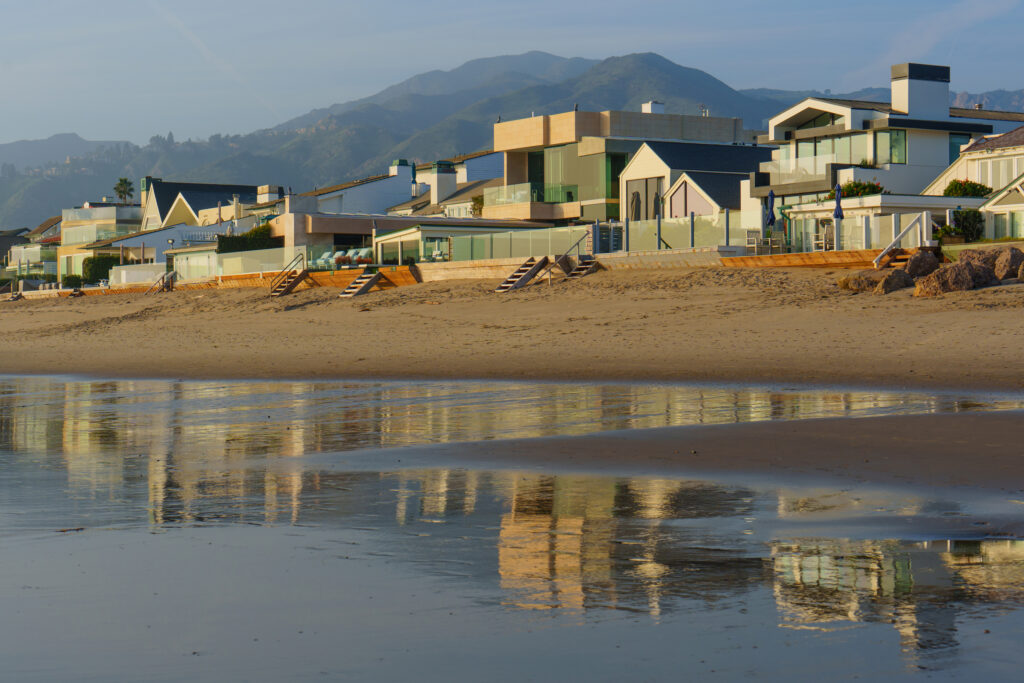
Cliffside Drive, Birdview Avenue and the seaward end of Dume Drive run along the mesa's edge, where lots widen, the ocean is continuous rather than glimpsed, and the required bluff setback becomes the governing line on every site plan. Houses here range from surviving low-slung ranches to long horizontal moderns set well back from the edge. Several parcels carry Riviera III key rights with stairs toward the rocky western end of Little Dume. Geotechnical review, drainage design and erosion history matter more on these streets than anywhere else on the point.
Zumirez Drive drops from Pacific Coast Highway toward the eastern side of the point, with larger parcels, mature windbreaks and, per local guides, the Riviera I gate that allows vehicles down toward the sand rather than only a footpath. The character is closer to a country lane than a beach street, and lots commonly run an acre or more. Paradise Cove lies immediately east, where the State Lands Commission and Coastal Commission acted in 2014 to restore free walk-in public access across the beach to the pier.
Wildlife Road, Portshead Road, Selfridge Drive, Whitesands Place and Boniface Drive form the quiet middle of the mesa, flat and gridded, where half-acre to acre lots hold ranch houses, replacement moderns, orchards and the occasional riding ring. Local guides place most Riviera II rights here, with a path to the sandiest middle stretch of Little Dume, which is why interior lots without ocean views can trade close to view parcels. These are the streets where the neighbourhood functions as a neighbourhood rather than as a viewpoint.
Heathercliff Road is the mesa's front door and its errand street, carrying Point Dume Village at 29169 to 29211 Heathercliff with a grocery, cafes and services, plus the condominium clusters that give the area its only attached housing. Fernhill Drive nearby holds Malibu Elementary, formed in 2019 from Juan Cabrillo and Point Dume Marine Science and still running a marine science programme with an on-site aquarium. For families, this corner is why Point Dume works day to day without a drive down the coast.
Northwest of the point, Zuma Beach gives the mesa 1.8 miles of county shoreline, roughly 105 acres with eight lots and about two thousand parking spaces, which absorbs summer crowds that would otherwise press against the neighbourhood. Beyond it, Trancas and Broad Beach continue the coast toward the county line with a different product: sand-front rows rather than mesa acreage. Many Point Dume buyers shop both, weighing land and quiet against direct frontage, and the two markets trade on separate logic.
View West to Zuma and Broad BeachEducation
All four Malibu public campuses currently belong to Santa Monica-Malibu Unified; separation agreements toward an independent Malibu district were approved in late 2025 with state-level steps still outstanding, and assignment always follows the individual parcel, so confirm any address with the district and confirm admissions directly with private schools.
Common Questions
Work With Ben
Point Dume trades on details that never reach a listing photo: which tract a beach key belongs to, how a bluff setback was drawn, what a septic permit allows. Tell Ben what you are after and he will track it street by street, including houses that change hands off market.
Start the ConversationBen will reach out shortly to set up your tour.