Home / Neighborhoods / Holmby Hills
Holmby Hills Homes for Sale
The quietest corner of the Platinum Triangle, where the city’s largest estates hide behind the deepest hedges.
Home / Neighborhoods / Holmby Hills
The quietest corner of the Platinum Triangle, where the city’s largest estates hide behind the deepest hedges.
About the Neighborhood
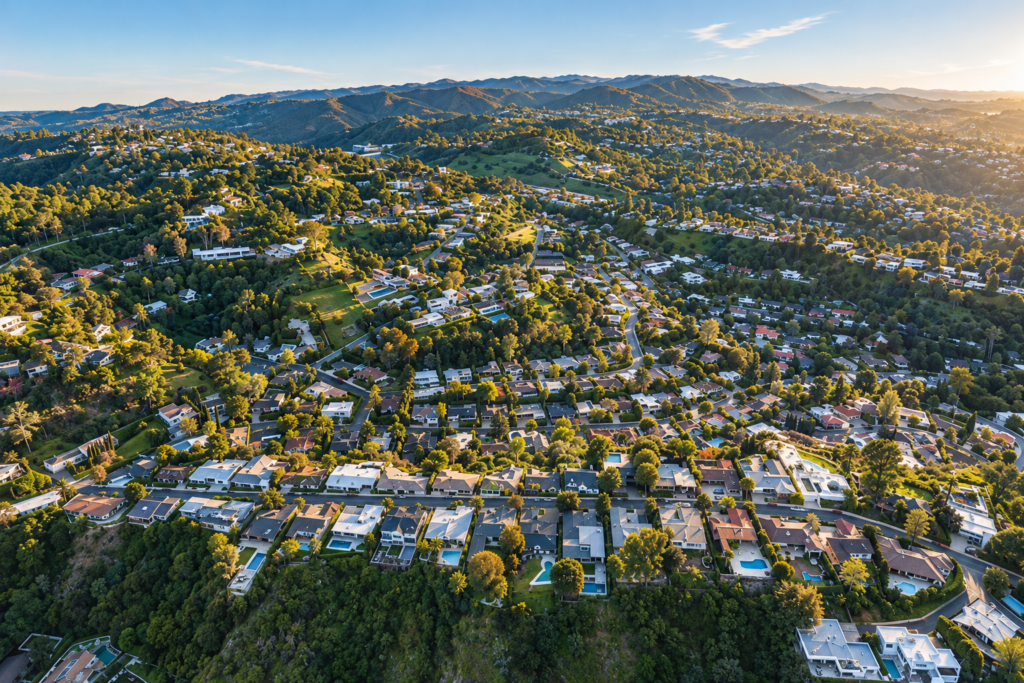
Holmby Hills grew out of the landholdings of Arthur Letts Sr., the founder of the Broadway department store, who acquired the former Wolfskill ranch west of Beverly Hills and named his planned district after Holdenby, the English hamlet of his birth. After Letts died in 1923, his son-in-law Harold Janss and the Janss Investment Company — the same firm developing Westwood and donating land for the UCLA campus — subdivided Holmby Hills through the mid-1920s. The developers buried electric and telephone lines, installed custom streetlamps that still mark the neighborhood, and zoned for estate-scale lots, establishing the template Holmby Hills real estate follows a century later.
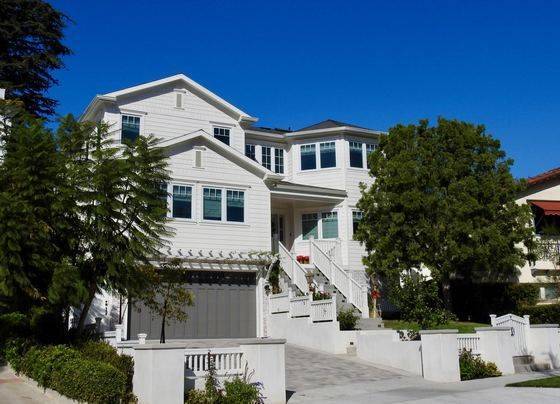
The housing stock is dominated by large estates from the 1920s and 1930s — Georgian, Tudor, Monterey Colonial and Mediterranean designs by architects such as Paul R. Williams, Wallace Neff and Gordon Kaufmann — set behind deep landscaped setbacks on Mapleton Drive, Carolwood Drive, Charing Cross Road, Baroda Drive and South Mapleton toward Holmby Park. Sunset Boulevard, once a two-lane country road, now divides the district: the larger parcels sit north of Sunset in zip code 90077, while the blocks south toward Holmby Park carry 90024. Later decades added postwar and contemporary mansions, but full-acre-plus lots remain the defining unit.
Holmby Hills lies entirely within the City of Los Angeles, so development follows the LA municipal code rather than Beverly Hills rules. Much of the district carries large-lot estate zoning — RE40 and RE20 classifications requiring 40,000 or 20,000 square-foot minimum lots in most of the area — and hillside-designated parcels fall under the Baseline Hillside Ordinance's floor-area, height and grading limits. The Holmby Hills Homeowners Association and the Holmby-Westwood property owners group monitor projects, and the Bel Air-Beverly Crest Neighborhood Council reviews land-use matters. There is no gate and no CC&R regime across the district; control is municipal and reputational.
The neighborhood's practical texture is quiet and green: no commercial uses inside the district, Holmby Park with its lawn-bowling green and walking loop at the southern edge, and the Los Angeles Country Club grounds along the Beverly Hills boundary. Westwood Village, UCLA and the retail of Beverly Hills are each about a five-minute drive. Sunset Boulevard supplies fast east-west access but also constant through traffic, and school-run congestion around the Harvard-Westlake middle campus on North Faring Road is a known rhythm on weekday mornings. Buyers searching homes for sale in Holmby Hills are usually comparing it directly with Bel Air and the Beverly Hills Flats.
Verification for buyers starts with zoning and hillside status: confirm the parcel's RE classification, whether Baseline Hillside rules apply, and what the buildable envelope allows before assuming an estate can be expanded or replaced at scale. Review any recorded easements and tennis-court or guesthouse entitlements on older estates, and check tree-removal rules for protected species. School assignment is LAUSD — commonly Warner Avenue Elementary, Emerson Community Charter and University High School — and should be confirmed through the district's Resident School Identifier. Finally, walk Sunset-adjacent parcels at peak hours; traffic noise varies sharply between the boulevard frontage and the interior drives.
Life Here
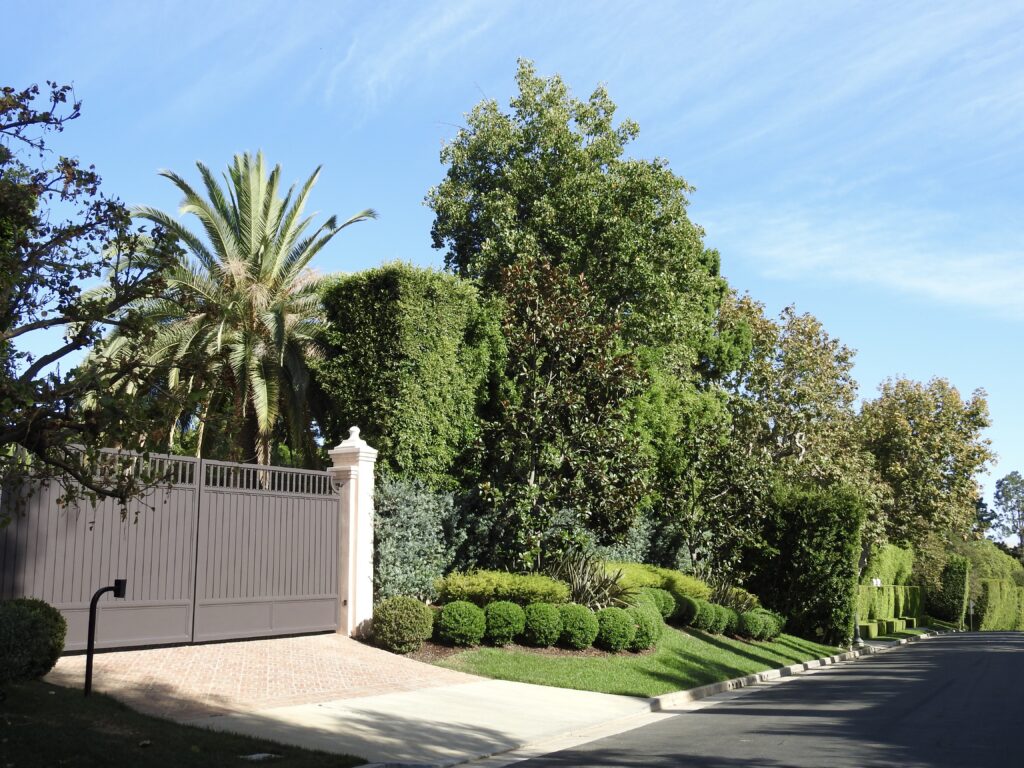
Acreage in the middle of the city. Estates here have motor courts, not driveways.
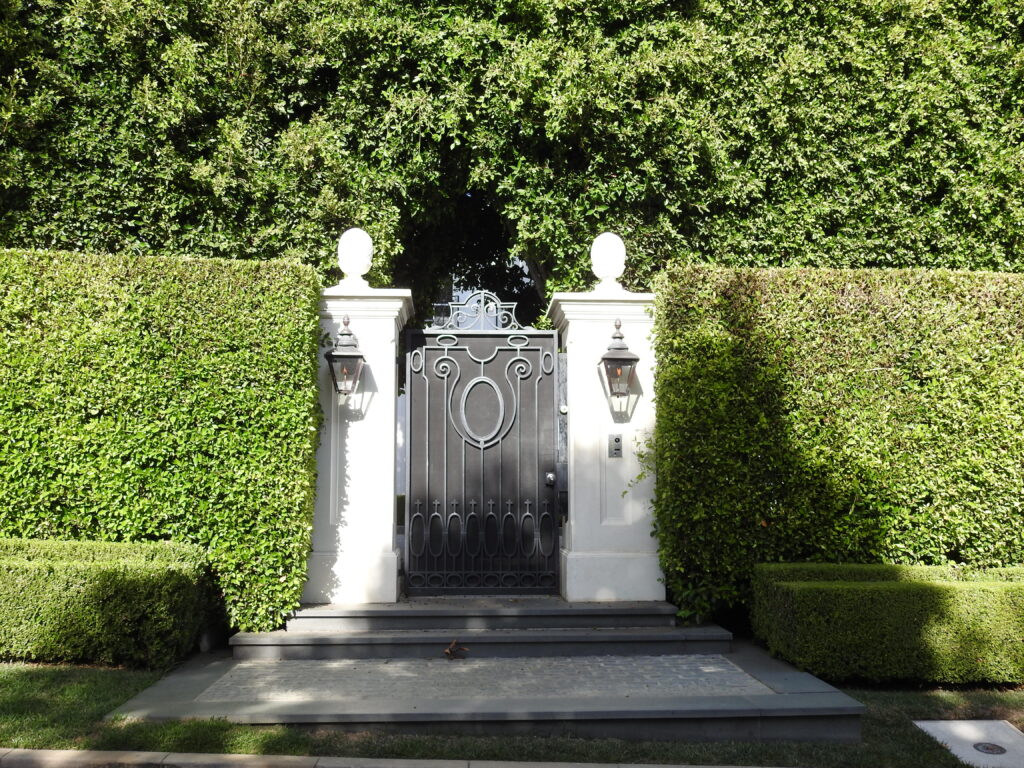
No tour buses, no signage, no noise. Holmby is where privacy is the ultimate amenity.
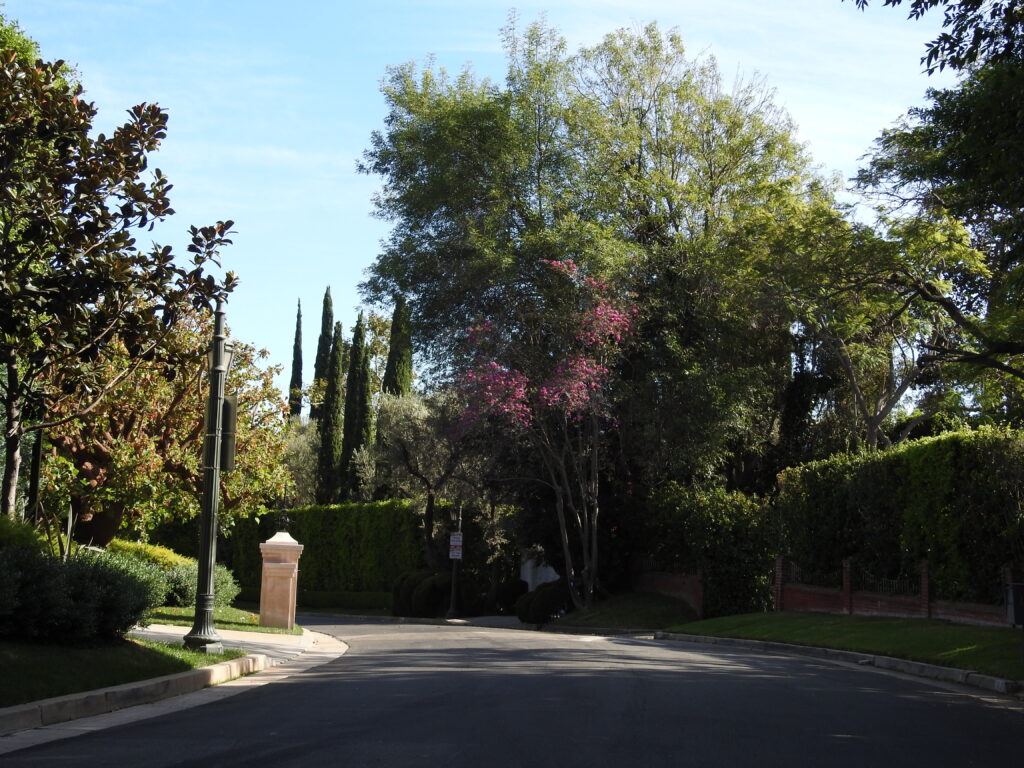
From the Spelling Manor to Carolwood Drive itself, these blocks are the history of the LA estate.
History
Holmby Hills descends from a department store. Arthur Letts Sr., the English-born founder of the Broadway, bought the old Wolfskill ranch west of Beverly Hills, land the neighborhood association's historians record as costing about $100 an acre, and reserved roughly 400 acres for an estate district of his own design. Letts died in May 1923 before building it; his son-in-law Harold Janss and the Janss Investment Company, then developing Westwood and selling the acreage that brought UCLA west, carried out the subdivision through the mid-1920s. The developers buried the electric and telephone lines, commissioned distinctive street lamps from the city's Bureau of Street Lighting, and secured estate-scale lots through zoning, decisions that still govern how Holmby Hills real estate looks and trades a century on.
The name is a memory of Northamptonshire. Letts was born near Holdenby, an English village whose name was historically rendered and pronounced Holmby, as in Holmby House, where Charles I was held in 1647; by most accounts Letts, a devoted Anglophile and gardener, had already given the name Holmby House to his own Los Angeles estate before it passed to the new district. The Janss firm spread the word liberally afterward, on Holmby Hall along Westwood Village's retail spine and Holmby Avenue farther south, but the hills kept its purest expression: a district conceived as English parkland, estate lots under mature trees, with no commercial parcel inside its boundaries then or now.
Holmby Park, at the district's southern seam on Club View Drive, is the neighborhood's public face. Its lawn bowling club dates to 1927, and its par-3 course, long known as the Holmby Park Pony Course and recorded by golf historians as opening in 1929, was later renamed for Occidental Petroleum founder and Holmby Hills resident Armand Hammer. With the Los Angeles Country Club running the eastern boundary, the park completes a green frame the estates borrow at no cost. By the postwar decades, the triangle formed with Beverly Hills and Bel Air had acquired its industry shorthand, the Platinum Triangle of Los Angeles, and Holmby Hills settled into its role as the smallest, scarcest and most estate-dense corner of the three.
Architecture
The estate stock carries verified signatures. Robert D. Farquhar, architect of the California Club and the Clark Library, designed Owlwood at 141 South Carolwood Drive, completed in the mid-1930s in Italianate style for Florence Letts Quinn, Arthur Letts' widow; it later housed Joseph Schenck, Tony Curtis, and Sonny and Cher. Arthur R. Kelly's 1927 Gothic-Tudor manor for Arthur Letts Jr. on Charing Cross Road became, decades later, the Playboy Mansion. Paul R. Williams designed the 1936 Jay Paley house on Brooklawn Drive, for decades afterward the home of hotelier Barron Hilton, and Wallace Neff's late-career Singleton Estate of 1970 on Delfern Drive, with grounds by landscape architect Thomas Church, is a designated Los Angeles Historic-Cultural Monument.
No street condenses the neighborhood's story like Carolwood Drive. Walt Disney bought five acres at 355 North Carolwood in 1949 and built the house where he tested an idea at one-eighth scale: the Carolwood Pacific Railroad, a live-steam line whose 2,615 feet of track circled the property, ducked through a tunnel dug beneath his wife Lillian's flowerbeds, and pulled guests behind a locomotive named Lilly Belle in her honor. Disney credited the backyard railroad with helping inspire Disneyland, and his red barn workshop survives at the Los Angeles Live Steamers museum in Griffith Park. The street's name has since traveled into the industry itself: Carolwood Estates, the brokerage Ben Kruger calls home, takes its name from the drive.
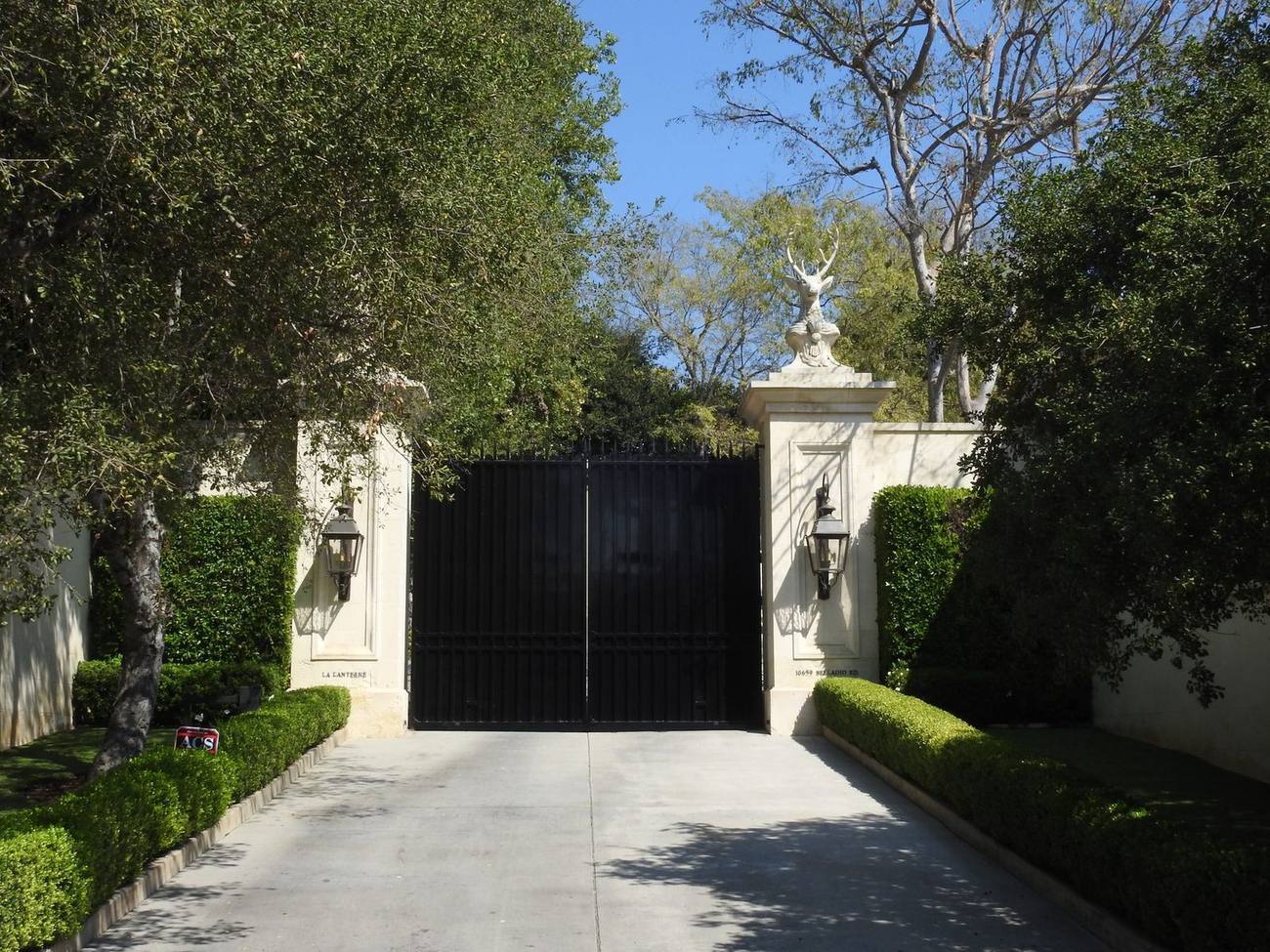
The district's visual grammar is scale held at a polite distance: tall hedges, deep setbacks, gated motor courts, houses that reveal themselves only past the second turn of the drive. The modern era's defining statement is The Manor at 594 South Mapleton Drive, completed in 1991 for Aaron and Candy Spelling on the site of Bing Crosby's former estate and commonly cited at more than 56,000 square feet, the largest house in Los Angeles when built. It sold to Petra Ecclestone in 2011, traded again in 2019 for $119.75 million, a California record at the time, and returned to market in 2022 asking $165 million. Newer rebuilds across the neighborhood follow the same instinct: replace the house, keep the hedge.
Understanding the Market
Scarcity is the market's first fact. Holmby Hills holds a small, essentially fixed inventory of estate parcels, far fewer than Bel Air or Beverly Hills, and its marquee streets can go years without an open-market trade. A meaningful share of Holmby Hills homes for sale never reach the multiple listing service at all; estates pass quietly between principals, and whisper listings are a structural feature of the neighborhood rather than a tactic. That changes how value is discovered: comparable sales are thin, land and provenance carry unusual weight, and the gap between asking and achievable can run wide in either direction. Representation with genuine access to off-market inventory is not a luxury here; it is the mechanics of entry.
Sunset Boulevard structures the market. North of Sunset, in the 90077 zip code, lie the district's largest parcels, along Carolwood, Charing Cross, Faring, Delfern, Baroda and North Mapleton, where acreage, gates and provenance concentrate and where the neighborhood's record trades have occurred. South of Sunset, in 90024, the blocks around Holmby Park, including South Mapleton and Club View, remain unambiguously estate-scale, The Manor itself sits on South Mapleton, but on a tighter grid, with the park and the Los Angeles Country Club as amenities and Warner Avenue Elementary nearby. Sunset frontage is the caveat that runs through both halves: traffic noise varies sharply between boulevard-adjacent parcels and the interior drives, and pricing follows it.
Entering this market rewards preparation over speed. Documented benchmarks sketch the ceiling, including the Playboy Mansion's $100 million sale in 2016, reported at the time as the largest in Los Angeles, Owlwood's $90 million off-market trade the same year, and The Manor's $119.75 million in 2019, but each estate is singular enough that benchmarks guide rather than govern. Buyers should expect proof-of-funds requests and confidentiality agreements before showings; should verify the zoning envelope, since RE40 and RE20 classifications dominate, along with any hillside designation, before assuming expansion rights; and should review easements and guesthouse entitlements on older estates. Patience matters most: the right house in Holmby Hills is bought when it becomes available, not when the buyer is ready.
Micro Neighborhoods
North of Sunset, the district's heart runs along Carolwood Drive, North Mapleton Drive, Charing Cross Road, Baroda Drive, Delfern Drive and North Faring Road, the largest parcels in the neighborhood and among the largest on the Westside. This is the geography of the famous houses: Walt Disney's railroad-ringed property on Carolwood, Farquhar's Owlwood, the 1927 Letts Jr. manor that became the Playboy Mansion. Lots commonly run to multiple acres behind gates and mature hedges, and inventory is the thinnest in the district. When press accounts invoke Holmby Hills estates, this is almost always the square mile they mean.
South of Sunset, South Mapleton Drive, Club View Drive and the surrounding blocks organize themselves around Holmby Park: the lawn bowling club founded in 1927, the Armand Hammer par-3 course, and the walking loop that gives the neighborhood its one genuinely public ritual. The Los Angeles Country Club borders the east. Estates remain grand, and The Manor, the largest house in the city when completed in 1991, anchors South Mapleton, but the fabric is subtly more approachable, with a walkable park, Warner Avenue Elementary nearby and Westwood's conveniences minutes away. Many buyers find the south side the more livable half.
At the district's southeastern seam, Comstock Avenue carries the transition from estate blocks to the high-rise line of the Wilshire Corridor. The edge reads as a gradient: single-family scale nearest Holmby Park, then, approaching Wilshire, full-service buildings that borrow the same country-club outlook. For some households the corridor edge is the practical compromise, with the park as a front yard and tower services in place of estate staffing; for estate owners it matters as context, because the buildings supply the pied-a-terre and downsizing demand that keeps the Holmby-adjacent market liquid even when the estate streets stand still.
Across Beverly Glen Boulevard, between the estate district and UCLA's eastern edge, Little Holmby is the Janss firm's gentler variation on the theme: storybook and period revival houses, Tudor, Spanish and French Norman among them, on winding tree-lined streets between Sunset Boulevard and Westwood Village. Warner Avenue Elementary sits within the neighborhood, and the campus, village and Holmby Park are all walkable. Scale and pricing run well below Holmby Hills proper, which makes Little Holmby the classic first move for buyers who love the canopy and the architecture but do not need the acreage.
View Little HolmbyImmediately south, the Wilshire Corridor's condominium towers run from Westwood Village toward the Los Angeles Country Club: full-service buildings, mainly from the 1960s through the 2000s, with valet, doormen and skyline views. For the Holmby Hills market the corridor functions as a companion rather than a rival. Estate owners downsize into it, families stage there during rebuilds, and out-of-town buyers use it to hold a Platinum Triangle address without land. Diligence differs from the estate streets, turning on HOA financials, building rules and, in certain towers, ground leases that define what is actually being owned.
View The Wilshire CorridorEducation
School assignment follows the individual parcel rather than the postcode, LAUSD boundaries and feeder patterns change, and enrollment should be confirmed directly with the district or school.
Common Questions
Keep Exploring
Deciding between them? Read Bel Air vs Holmby Hills.
Work With Ben
This market moves privately or not at all. Ben’s brokerage is named for its central street; start the conversation there.
Start the ConversationBen will reach out shortly to set up your tour.