Home / Neighborhoods / Beverly Hills
Beverly Hills Homes for Sale
The flats, the estates, and the most recognized residential address in the world.
Home / Neighborhoods / Beverly Hills
The flats, the estates, and the most recognized residential address in the world.
About the Neighborhood
Beverly Hills began as Rancho Rodeo de las Aguas, ranch land that the Rodeo Land and Water Company, led by Burton Green, began subdividing in 1906 after oil exploration disappointed. Landscape architect Wilbur David Cook drew the town plan, the Beverly Hills Hotel opened on Sunset Boulevard in 1912 to anchor sales, and the city incorporated on January 28, 1914. In 1923 residents voted down annexation to Los Angeles, keeping Beverly Hills an independent city of roughly 5.7 square miles surrounded by its larger neighbor, with its own police and fire departments, school district and municipal code — a distinction that still shapes Beverly Hills real estate.
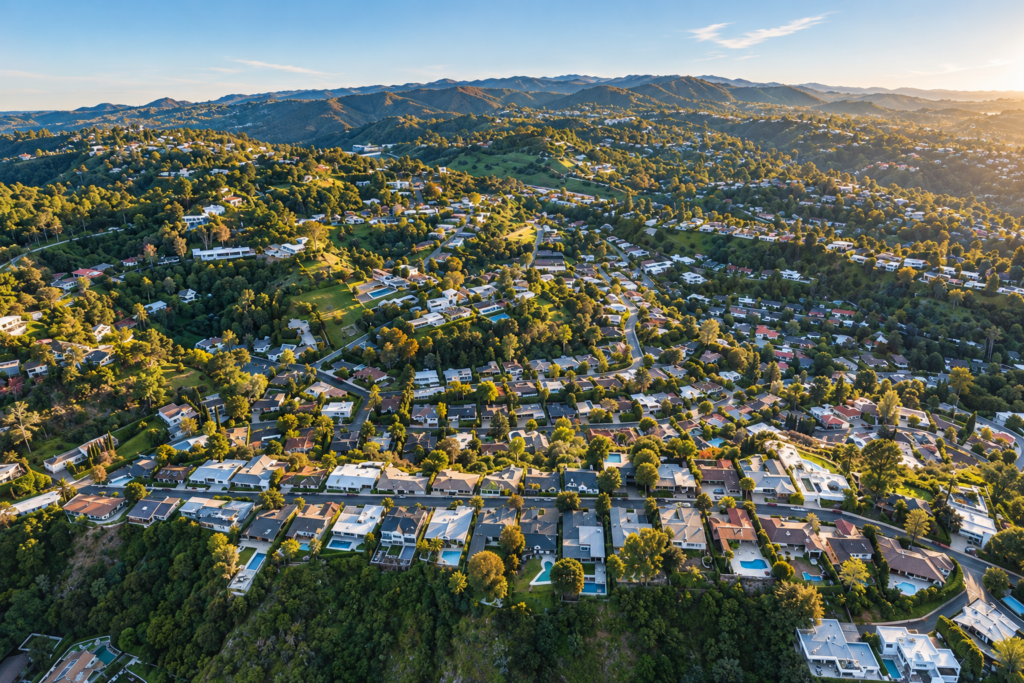
The housing stock divides into three clear bands. North of Santa Monica Boulevard, the Flats hold 1920s-1930s Spanish Colonial Revival, Mediterranean and Tudor houses on regular lots, giving way above Sunset to hillside estates and the single-story midcentury pads of Trousdale Estates. Between Santa Monica Boulevard and Wilshire, blocks mix smaller single-family homes and duplexes. South of Wilshire, the city is denser, with apartment and condominium buildings from the 1920s through the 1980s alongside single-family streets. Zip codes 90210, 90211 and 90212 cover the city, though 90210 also extends into Los Angeles hillside areas outside city limits.
Development is governed entirely by the Beverly Hills municipal code rather than Los Angeles rules. Single-family standards differ by area: Central Area lots allow two stories with design review for street-visible work, the Hillside Area carries its own height envelopes and grading limits, and Trousdale Estates is capped at 14 feet. The city's historic preservation ordinance, adopted in 2012, established a landmarks program and Mills Act incentives. Multifamily properties south of the boulevards fall under local rent stabilization. Because standards changed materially over the past decade, entitlement assumptions from older listings should always be rechecked against current code.
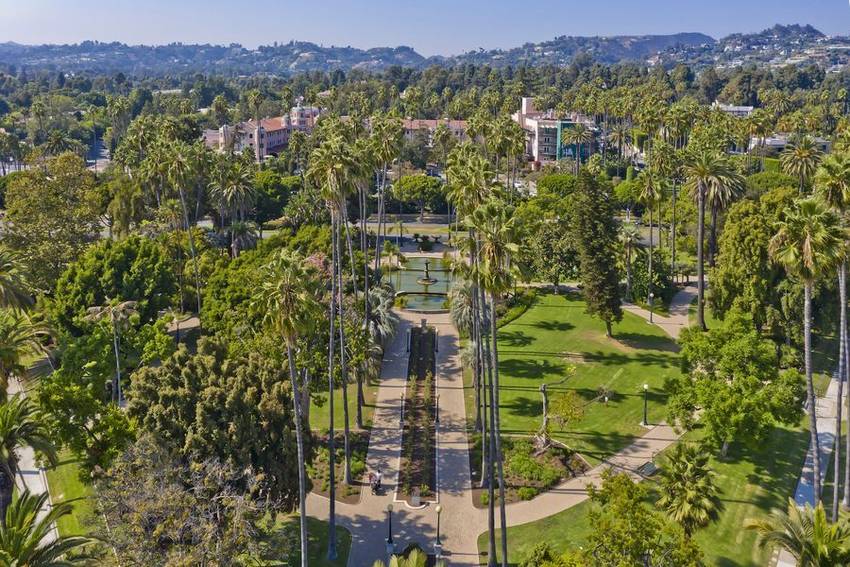
Practically, the city runs on the Golden Triangle — Rodeo Drive, Beverly Drive and the surrounding blocks of shops, offices and restaurants — plus neighborhood-serving retail along South Beverly Drive and Robertson Boulevard. Santa Monica and Wilshire Boulevards carry cross-town traffic, and the Metro D Line subway extension under Wilshire includes a Wilshire/Rodeo station in the Business Triangle reported as targeted for a later phase in 2027. Residents cite city services as a core reason to buy: municipal police and fire, its own water utility, well-kept parks like Beverly Gardens and Roxbury Park, and a compact civic center with library and farmers market.
Buyers should verify jurisdiction first: many 90210 addresses north of the city line are Beverly Hills Post Office areas inside the City of Los Angeles, with LAUSD schools and LA city services despite the mailing address. Within the city, confirm school assignment through the Beverly Hills Unified school finder, since the district consolidated to two elementary campuses in 2024. Check the parcel's single-family area classification, any landmark or survey status, rent stabilization coverage for income property, and, in the hillside sections, geology and fire-zone requirements. Homes for sale in Beverly Hills trade on these distinctions as much as on square footage. For help choosing an agent here, see Ben Kruger's Beverly Hills real estate agent page.
Life Here

Wide streets, deep lots and the most consistent estate blocks in America, minutes from everything on foot or by car.
A city built around its residents: schools, safety and upkeep that explain the premium on their own.

Global demand, finite supply, and a private market that moves before the public one. Access decides outcomes here.
History
Beverly Hills began as Rancho Rodeo de las Aguas — "the gathering of the waters" — roughly 4,500 acres settled in the 1820s and formally granted in 1838 to María Rita Valdez, a descendant of the founding pobladores of Los Angeles. She ran cattle and horses here until 1854, when she sold the ranch to Benjamin Wilson and Henry Hancock. Later owners Henry Hammel and Andrew Denker farmed lima beans across the property and, by 1888, had planned a town on it called Morocco. The land boom of the 1880s collapsed before Morocco built much of anything, and the bean fields stayed bean fields for another generation.
In 1900 Burton E. Green's syndicate bought the ranch hunting for oil. Its Amalgamated Oil Company found water instead, so in 1906 they reorganized as the Rodeo Land and Water Company, renamed the property Beverly Hills — after Beverly Farms, Massachusetts — and hired landscape architect Wilbur D. Cook to plan a garden suburb. Cook's 1907 plan set the pattern that defines the city today: broad curving streets north of Santa Monica Boulevard, a triangular business district, and parkways planted street by street with different trees. Green built the Beverly Hills Hotel, opened in 1912 to anchor lot sales — two years before the city incorporated in January 1914.
Independence was tested in 1923, when a water shortage pushed annexation to Los Angeles onto the ballot. Eight film-colony residents — Mary Pickford, Douglas Fairbanks, Will Rogers, Harold Lloyd, Tom Mix, Fred Niblo, Conrad Nagel, and Rudolph Valentino — campaigned to keep the city independent, and on April 24, 1923, annexation lost 507 to 337. The city then engineered its own answer: a 1928 waterworks whose Romanesque tower, dressed as a church campanile, actually housed the aerators that scrubbed the sulfur taste from local well water. That building survives as the Academy's Fairbanks Center, and the city it kept independent now holds about 32,700 residents in 5.7 square miles.
Architecture
The 1920s gave Beverly Hills its foundational architecture: period revival at estate scale. Gordon Kaufmann designed Greystone (1927-28), the Doheny family's 55-room mansion that the city now owns as a public park; Sumner Spaulding designed Greenacres, Harold Lloyd's 1928 Benedict Canyon estate; and Wallace Neff's 1926 Spanish Colonial Revival Caldwell Residence still stands on North Linden Drive. Roland Coate brought his restrained Colonial Revival manner to Summit Drive in the following decade, and Paul R. Williams — who would later add the Crescent Wing and the script signage to the Beverly Hills Hotel — designed period houses across the flats. Spanish, Mediterranean, Tudor, and Colonial vocabularies still set the streetscape tone on both sides of Sunset.
The second layer arrived after the war. When the city annexed the old Doheny Ranch in the mid-1950s, developer Paul Trousdale cut its 410 acres into 532 lots governed by an architectural committee, height limits, and a low, largely single-story profile — and buyers commissioned A. Quincy Jones, Harold Levitt, Paul R. Williams, and a Frank Lloyd Wright design, with Allen Siple supervising. Down on the flats, John Elgin Woolf and his followers reworked traditional houses into Hollywood Regency: mansard roofs, discreet street facades, oversized pavilion doors. Between Trousdale's modernism and Woolf's theatrical classicism, postwar Beverly Hills built a second architectural identity as distinct as its first.
Today the pressure runs the other way: on many streets an older, unrenovated house trades close to land value, and replacement is the default math. The city answers with process. Street-visible single-family work in the Central Area goes through design review — staff-level approval for a design that holds to a single recognized style, a commission hearing for everything else — while Trousdale keeps standards codified in 1987 and hillside projects face their own review. Preservation arrived late: a 2012 ordinance, prompted by the near-demolition of Richard Neutra's Kronish House, created a landmark register that began with the Beverly Hills Hotel and now includes Greystone and the 1920 Spadena "Witch's House." Amendments in 2015 narrowed the criteria, adding owner-consent hurdles and a master-architect test, and designations have slowed markedly since.
Understanding the Market
Beverly Hills pricing rests on a few durable structures. The first is municipal: homes inside the city limits come with the city's own school district, police force, and fire department, and that package — more than any single amenity — separates these blocks from the Los Angeles streets around them. The second is topographic. The flats between Santa Monica Boulevard and Sunset offer level, wide, regularly shaped lots with rear alleys, which is why land there carries the city's strongest per-foot values; the hills trade that regularity for acreage, privacy, and views. Across both, lot-value economics dominate — dated houses are routinely bought for their land, and rebuilding is constant. At the top, the trophy market runs on discretion: quiet listings, private showings, and sales that never reach the open market.
The Golden Triangle — the commercial wedge where Santa Monica and Wilshire boulevards converge, its eastern edge drawn variously at Canon or Rexford Drive — matters to residential value in two ways. Directly, it puts Rodeo Drive retail, hotels, restaurants, and the Wallis Annenberg Center within a walk of the flats and the condominium streets south of Wilshire, an unusual pairing of estate neighborhood and genuine business district. Indirectly, its commercial property-tax and business base helps fund the services and schools that anchor residential demand citywide. The relationship runs both directions: the housing supplies the customers, and the district's health is a fair proxy for the city's.
Choosing between districts is less a matter of taste than of which structure you are buying into. Buyers who want the schools and city services must stay inside the city limits — a Beverly Hills address in the Post Office area comes with Los Angeles schools and services instead. Buyers who want land should weigh the flats' level, buildable lots against the hills' acreage, with its slopes and access to manage. Renovators should map the regulatory terrain first: Central Area design review, Trousdale's height and view protections, hillside permitting, and — for architect-designed houses — the landmark register and the city's historic resources surveys. Each district resolves these trade-offs differently, which is why they deserve to be weighed one at a time.
Micro Neighborhoods
Annexed in the mid-1950s from the Doheny Ranch, Trousdale Estates is 410 acres cut into 532 pad lots above the city's northeast corner. Height limits and view protections, codified in the 1987 Trousdale ordinance, keep the profile low and largely single-story, and original commissions by A. Quincy Jones, Harold Levitt, and Paul R. Williams made it a mid-century reference point.
View Trousdale EstatesThe Flats run between Santa Monica Boulevard and Sunset, on the curving, tree-lined blocks of Wilbur Cook's 1907 plan. Lots are level, wide, and regular, with rear alleys keeping garages and service off the street — the qualities that make this the city's benchmark land. The housing spans 1920s period revival to new construction, all of it inside the school district.
View The Beverly Hills FlatsBenedict Canyon climbs north from near the Beverly Hills Hotel into the Santa Monica Mountains. Only its mouth sits inside the city limits; most of the canyon carries a Beverly Hills address under Los Angeles jurisdiction. The draw is acreage and seclusion minutes from the flats — this is where Sumner Spaulding built Greenacres, Harold Lloyd's 1928 estate, later subdivided but still standing.
View Benedict CanyonBeverly Hills Post Office is the 90210 territory north of the city line, taking in Coldwater and Franklin canyons up to Mulholland Drive — served by the Beverly Hills post office but governed by Los Angeles, with LAUSD schools. Parcels run larger and the terrain wilder than in the city proper, and gated enclaves and view promontories give it a distinct estate market.
View Beverly Hills Post OfficeNorth of Sunset, the flats give way to the estate streets — Crescent, Canon, Beverly, Rexford, and the drives above them — where Cook's plan traded the grid for contours. Lots widen to a half acre and well beyond, hedges replace sightlines, and the great 1920s and 1930s commissions by Neff, Coate, and their peers concentrate here, on and around Summit Drive.
South of Wilshire is the city's entry point: Spanish and Tudor cottages, duplexes, and full-service condominiums on a walkable grid within reach of the Golden Triangle. Lots are smaller but the citizenship is identical — same school district, same police and fire — which is why these blocks hold value against much larger houses just across the Los Angeles line.
Condominiums
Education
School assignment follows the individual parcel rather than the postcode — many 90210 addresses are outside the district entirely — and boundaries and configurations change, so confirm enrollment directly with BHUSD or the school.
Common Questions
Keep Exploring

Also in this part of the city: Trousdale Estates, The Flats
Further Reading
Work With Ben
The best of this market never reaches a portal. Tell Ben what you are looking for and see what is really available, including off market.
Start the ConversationBen will reach out shortly to set up your tour.