Home / Neighborhoods / The Sunset Strip
Sunset Strip Homes and Condos for Sale
A mile and a half of Sunset Boulevard, and the hillside streets that look down on it.
Home / Neighborhoods / The Sunset Strip
A mile and a half of Sunset Boulevard, and the hillside streets that look down on it.
About the Neighborhood
The Sunset Strip is the stretch of Sunset Boulevard running through West Hollywood, roughly from Crescent Heights Boulevard to the Beverly Hills line at Doheny Drive. For decades the corridor was unincorporated Los Angeles County land, and that jurisdictional gap shaped it: nightclubs such as the Trocadero (1934), Ciro's (1940) and the Mocambo (1941) chose the county strip beside the film industry, and by the 1960s the rock clubs and the 1966 curfew demonstrations had fixed it in music history. When West Hollywood incorporated on November 29, 1984, the new city inherited the Strip whole and made it a civic centerpiece.
Housing on and around the Strip splits into distinct types. The boulevard itself carries hotels, offices, billboards and residential towers, including Sierra Towers (1965) and Shoreham Towers near its western end, along with newer condominium buildings. The blocks south hold 1920s courtyard apartments, fourplexes and small condo buildings inside West Hollywood city limits. North of the boulevard, hillside lanes such as Sunset Plaza Drive, Queens Road and the approaches to the Bird Streets sit in the City of Los Angeles and carry midcentury and contemporary view houses. Two jurisdictions, one address line, and materially different rules on either side.
On the West Hollywood side, the Sunset Specific Plan, adopted in 1996 and updated since, governs the corridor: it treats billboards and tall walls as a regulated design resource, sets standards for hotels and mixed-use projects, and channels approvals through West Hollywood's own zoning code rather than Los Angeles's. Apartment buildings fall under the city's rent stabilization ordinance, in force since 1985, and rentals of under thirty-one days are prohibited citywide. One lot north of the city boundary the framework changes entirely, to the Baseline Hillside Ordinance, LADBS hillside review and Very High Fire Hazard Severity Zone requirements.
Living here means accepting the corridor's rhythm. Nightlife, hotel traffic and event closures are part of the week, and the trade-off is walkability rare in Los Angeles: restaurants at Sunset Plaza, grocery and gym within blocks, and the Design District and Santa Monica Boulevard a short walk downhill. Tower residents get valet, doormen, and skyline-to-ocean views; hillside residents just above get quiet cul-de-sacs minutes from the noise. Billboard light, weekend congestion and award-season street management vary sharply block by block, so time-of-day visits matter more here than in most neighborhoods.
Buyers should first pin down jurisdiction, since West Hollywood and Los Angeles differ on zoning, rent regulation, short-term rentals and building review. For condominiums, read the HOA budget, reserves, litigation history and any pending facade or seismic work, and ask about soft-story retrofit status in older buildings. For income property, confirm which units are rent-stabilized and at what rents, because West Hollywood's ordinance governs increases and tenancies. For hillside houses north of the boundary, the standard Los Angeles hillside checks apply, including fire-zone insurability. In every case, run the school assignment by parcel rather than assumption.
Life Here

Restaurants, hotels and music venues sit at street level along Sunset, with the Sunset Plaza retail block a short distance east.

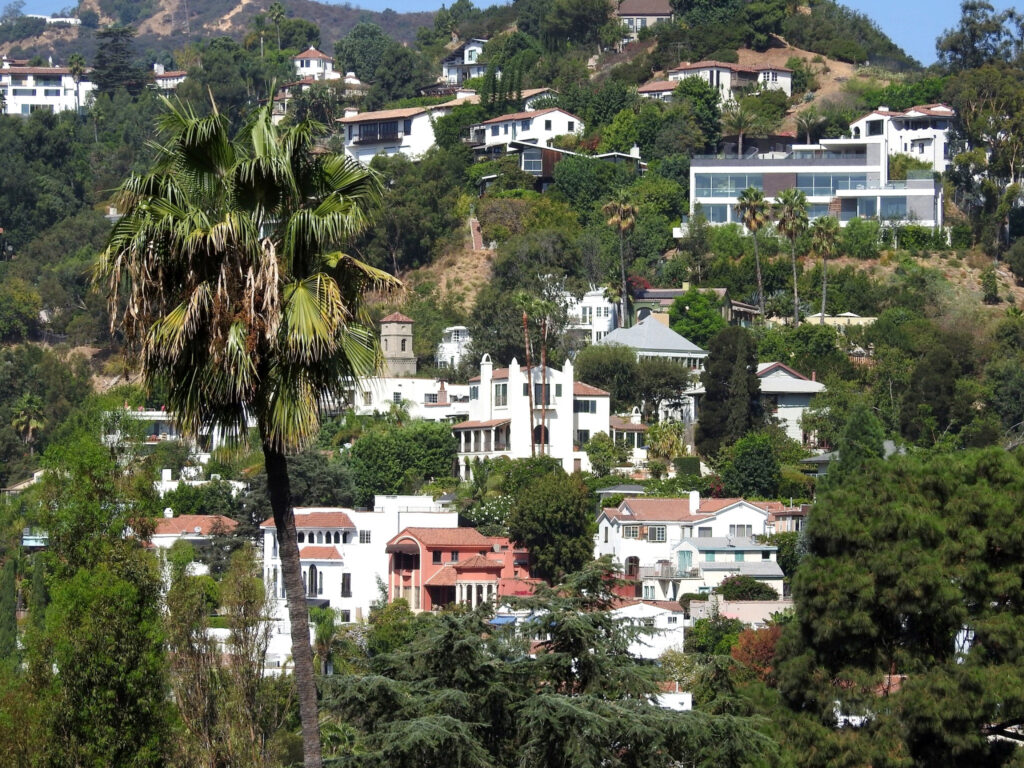
Detached houses on the streets climbing north sit within minutes of the boulevard but away from its traffic, on steep lots with basin views.
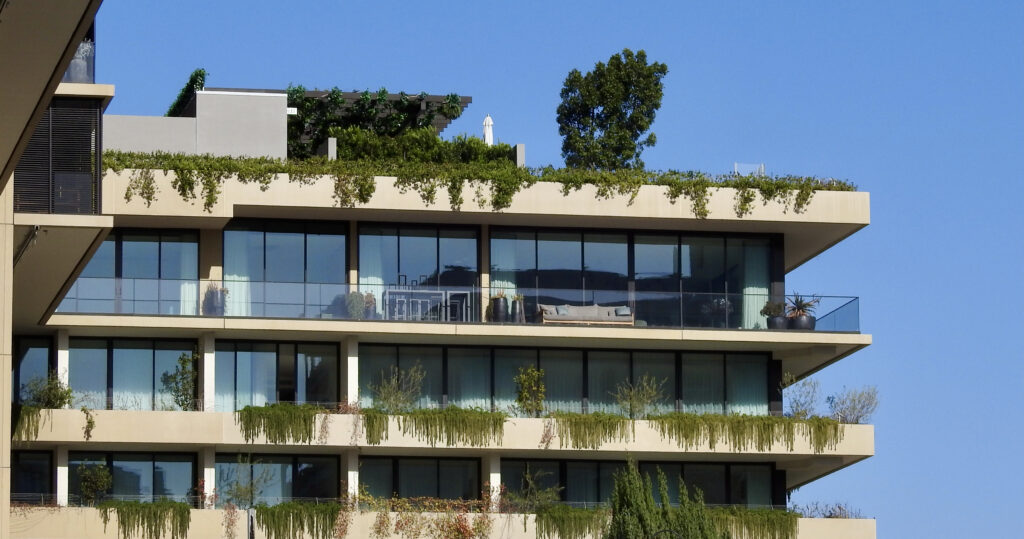
Attached homes range from 1920s courtyard and Art Deco buildings to Sierra Towers of 1965 and hotel-branded residences completed in 2021.
History
The Strip's character was set by a line on a map. Because the corridor remained unincorporated Los Angeles County territory while Los Angeles and Beverly Hills grew around it, its nightlife answered to the county sheriff rather than the LAPD, and enforcement ran famously lighter. Through the 1930s that gap drew backroom gambling houses such as the Clover Club alongside the supper clubs, and geography did the rest: Sunset Boulevard was the direct route between the studios in Hollywood and the executives' homes in Beverly Hills, so the industry's money passed the door nightly. County-era licensing stayed looser than the city's for decades, which is why the Strip developed as an entertainment economy first and became a residential address only later.
The rock era gave the Strip its second identity. The Whisky a Go Go opened at Sunset and Clark in January 1964, and by mid-decade the corridor's clubs were the proving ground of Los Angeles rock. On November 12, 1966, enforcement of a decades-old 10 p.m. curfew for minors sparked demonstrations outside Pandora's Box at Sunset and Crescent Heights, just beyond today's city line; the City of West Hollywood's own historical account puts the crowds at one to three thousand, and Stephen Stills answered with 'For What It's Worth.' In the years that followed, hand-painted rock billboards, documented in photographer Robert Landau's work, turned the boulevard into the music industry's front page and made the signage itself part of the Strip's identity.
The 2010s and 2020s brought the Strip's residential turn. The West Hollywood EDITION opened at 9040 Sunset in November 2019, a John Pawson-designed hotel carrying twenty private residences. In 2021 the Pendry West Hollywood and its forty Pendry Residences opened on the former House of Blues site, a development by AECOM Capital and Combined Properties reported at more than five hundred million dollars; after an ownership change, the property was rebranded The Sun Rose West Hollywood in 2025, and residence sales resumed under the new name in early 2026, per The Real Deal. 8899 Beverly, the Olson Kundig condominium conversion often mentioned alongside these projects, actually sits on Beverly Boulevard near the Design District, not on the Strip itself.
Architecture
The tower story begins in the county era, when high-rise apartment builders found room here that the neighboring cities would not give them. Sierra Towers, completed in 1965 at 9255 Doheny Road, was designed by Jack A. Charney, who had studied under Richard Neutra and Rudolph Schindler; it rose thirty-one stories as a rental building and converted to condominiums in 1974. Nearby, Empire West on Alta Loma Road is a 1964 design attributed to Daniel Dworsky, its deep balconies setting a solid-void rhythm the architecture trade still admires, while Shoreham Towers, dated by listing records to 1963, filled out the cluster. Together they created the West End's tower row, still the densest concentration of full-service condos on the Sunset Strip.
Above the boulevard the architecture changes register entirely. The lanes that climb north, Sunset Plaza Drive, Queens Road, Kings Road and their branches, sit in the City of Los Angeles and carry the hillside stock: 1950s and 1960s post-and-beam houses cantilevered off graded pads, walls of glass aimed at the basin, and a growing share of contemporary rebuilds that trade midcentury restraint for scale. The pattern was set by topography, small view lots reached by narrow switchbacks, and it rewards architecture that lives on its section rather than its facade. The best streets hold documented midcentury work alongside newer speculative houses, and the jurisdictional line means hillside construction follows Los Angeles rules rather than West Hollywood's.
The newest generation imports the branded-residence model to the boulevard itself. At the EDITION, John Pawson's pale travertine-and-glass building carries its small collection of residences above the hotel, finished in the same reductive palette as the public rooms. At the former Pendry, now The Sun Rose, Ehrlich Yanai Rhee Chaney's architecture is paired with Martin Brudnizki interiors, and the forty residences ride above restaurants, screening room and hotel services. The type suits the Strip: small unit counts, hotel staffing, and architecture conceived for the corridor's scale rather than adapted to it. For buyers, these buildings read less like condominiums with amenities than like private floors of the hotels beneath them, with cost structures to match.
Understanding the Market
Sunset Strip condos sort into two tiers by era. The mid-1960s towers, Sierra Towers, Shoreham Towers and Empire West, offer full-service living, doormen, valet and pools, with floor plans and view axes that vary widely by line and by renovation; they remain the corridor's blue-chip resale stock. The 2019-2021 branded buildings trade at a premium for new construction and hotel services. Reported trades frame the top of the range: The Real Deal reported the then-Pendry penthouse's fourteen-million-dollar sale in 2023 as that year's priciest condominium trade in Los Angeles County, with remaining Sun Rose residences offered in the mid-seven figures as sales resumed. Below penthouse level the band widens considerably, so building-by-building comparison matters more than corridor averages.
The homes-versus-condos decision on the Strip is really a decision between two ways of holding a view. Hillside houses north of the boulevard deliver land, privacy and control, along with Los Angeles hillside diligence: geology, retaining walls, fire-zone insurance and construction logistics on narrow streets. Tower and branded condos deliver the same skyline with none of that, in exchange for association dues that reflect real staffing, and governance shared with neighbors. Older towers warrant review of reserves, remediation history and pending facade or systems work; newer buildings warrant scrutiny of how hotel and residence costs are allocated. Neither side is the value play; both price the Strip's scarcity, one in land and one in services.
The buyer profile here skews lock-and-leave: entertainment-industry principals keeping a base near the studios and agencies, out-of-town owners wanting a pied-a-terre with hotel services, and downsizers trading hillside houses for a single elevator ride. Sunset Strip real estate rewards specific questions rather than general ones. Which jurisdiction, and therefore which rulebook? Which view axis, south across the basin or along the corridor's billboards? What does the association actually staff, and what does the monthly figure buy? Walk the block at 11 p.m. on a Saturday and again on a Tuesday morning; the corridor's rhythm varies more block by block than any listing conveys, and the right building is the one whose rhythm matches yours.
Micro Neighborhoods
Directly above the Strip's western blocks, the Bird Streets take their name from lanes like Blue Jay Way and Oriole Drive, the former fixed in music history by George Harrison's 1967 song. The enclave sits in the City of Los Angeles, in the hills above Doheny Drive, and carries some of the hillside's most valuable real estate: midcentury view houses, rebuilt contemporaries and speculative modern estates on small, closely held lots. Its residents use the Strip as their main street, which is precisely the trade, five minutes from the corridor's restaurants and clubs, and a world above them.
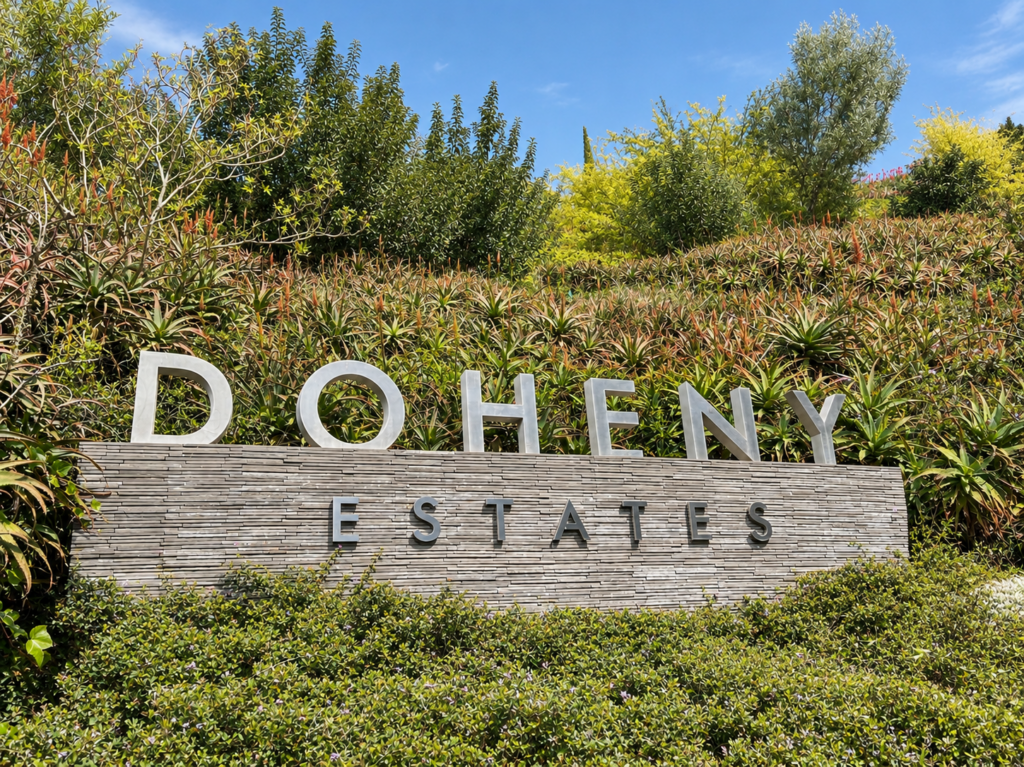
View The Bird StreetsDoheny Estates occupies the hillside pocket where the Strip meets the Beverly Hills line, rising north of Sunset around the upper reaches of Doheny Drive. Like the Bird Streets, it sits on the Los Angeles side of the boundary, so hillside construction follows Los Angeles rules rather than West Hollywood's. The stock runs from 1950s and 1960s pads to comprehensively rebuilt contemporary houses, many oriented south over the tower row toward the basin. For buyers weighing Sunset Strip condos against a house, this is often the house side of the comparison: privacy and land, minutes from the corridor.
View Doheny EstatesSunset Plaza is the Strip's most composed stretch, a run of 1930s Georgian and Regency-styled retail buildings assembled by the Montgomery family and, by longstanding account, still under family ownership today. The sidewalk cafes give the corridor its daytime life, and Sunset Plaza Drive climbs directly behind into one of the hillside's signature residential streets. The surrounding blocks mix view houses above the boulevard with apartments and small condo buildings below it, and addresses here trade partly on the name itself. It is the rare piece of the Strip that has looked essentially like itself for ninety years.
View Sunset PlazaThe Strip's western terminus, where Sunset approaches Doheny Drive, holds the corridor's residential skyline: Sierra Towers at 9255 Doheny Road, Shoreham Towers on its hillside cul-de-sac, Empire West on Alta Loma Road, and the EDITION's residences at 9040 Sunset. This cluster is where most searches for condos on the Sunset Strip actually land, and the buildings differ more than their proximity suggests, in era, services, floor plates and governance. The building directory profiles each tower individually, from the 1960s full-service originals to the newest branded residences, so the comparison can be made line by line.
View The West End Tower RowThe Strip's eastern gateway, from Sunset Plaza's edge toward Crescent Heights, carries the corridor's bohemian memory: the Chateau Marmont, opened in 1929 as an apartment house designed by William Douglas Lee and converted to a hotel in 1931, presides from its knoll on the Los Angeles side of the line. Below it, the boulevard holds a denser mix of clubs, offices and billboards, while the side streets south hold 1920s courtyard apartments and small condo buildings inside West Hollywood. Values here trade on walkability and history rather than skyline views, and the jurisdiction changes mid-block in places.
Between Sunset Plaza and the east Strip, lanes such as Queens Road, Kings Road and Marmont Lane climb into the hills, a central hillside of switchbacks, small pads and long views that runs at a quieter frequency than the boulevard two minutes below. The stock is eclectic, prewar cottages, midcentury pads and architect rebuilds, and parking, street width and geology vary house by house. These pockets sit in the City of Los Angeles, so hillside rules and fire-zone requirements apply. For many buyers they are the affordable-by-comparison route to living above the Sunset Strip.
Condominiums
Education
School assignment follows the individual parcel and district boundaries change, so confirm any address directly with LAUSD before making it part of a purchase decision.
Common Questions
Work With Ben
Towers, courtyard buildings and hillside houses trade very differently here. Tell Ben what you are looking for, including off market.
Start the ConversationBen will reach out shortly to set up your tour.